Women–Poetry–Translation

Jaehyun Kim

BA Thesis
Graphic Design Department
Royal Academy of Art, The Hague
April 2026

Last updated: April 5, 2026.

: Rewriting Feminist Voices across Text and Archive

Scroll

Contents

Table of contents preview
↓ Image from Archive
Chapter 0 image 1
Chapter 0 image 2
Chapter 0 image 3

Women–Poetry–Translation

Abstract

This research follows a translating journey through women’s voices, Korean feminist histories, and imperfect and interpretive translations, while attending to visual traces of women that have yet to be fully seen.

Focusing on the poetry of Korean feminist poet Kim Hyesoon and its English translations by Don Mee Choi, the study compares my own translations with Choi’s to examine how differences in word choice and grammatical structure shift meaning, tone, and emotional intensity, revealing the limits of equivalence in translation.

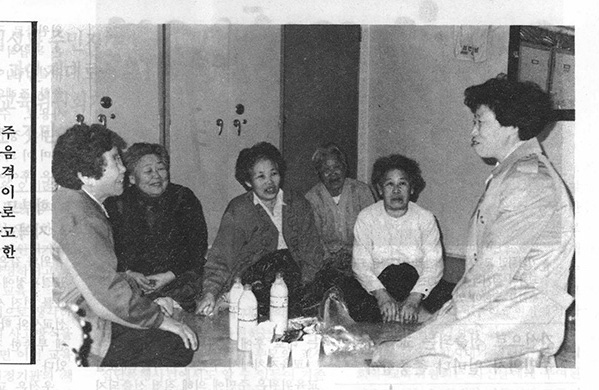
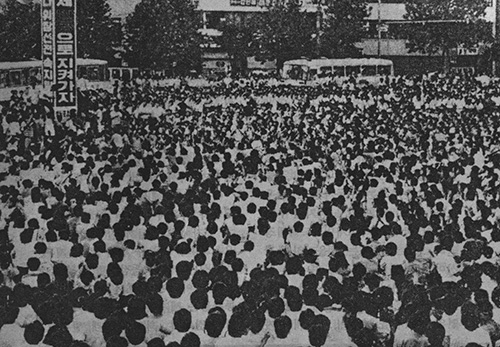
It also explores feminist print materials from the 1980s and 1990s in the Korea Democracy Foundation (KDF) Open Archive, analysing their visual language, including illustrations, photographs, and graphic compositions. These materials are understood not only as historical records of publishing as a central force in the women’s movement, but also as visual forms that vividly represent women’s lives and convey the aspirations and conditions of feminist struggle at the time.

By bringing poems and archival images into dialogue, the study identifies connections between literary and visual expressions, suggesting that the realities in Kim Hyesoon’s poetry are closely tied to the material conditions documented in feminist publications.

Ultimately, translation is understood as a practice that moves across languages, media, and histories, opening up multiple ways of reading feminist narratives and contributing to discussions on feminist representation and visual culture in Korea.

Keywords
women’s poetry, Kim Hyesoon, Don Mee Choi, translation, feminism, Korean women’s movement (1980s–1990s), women’s oppression, feminist publishing archives

fig. 1. Archive scan, 1994
Chapter 1 image 1
Chapter 1 image 2

Chapter 1

The First Encounter

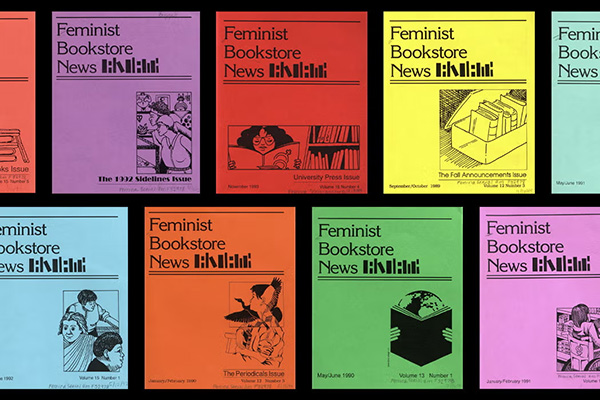
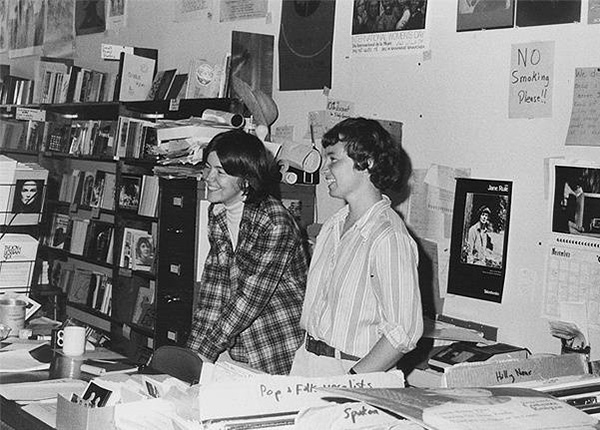
In 2025, during my third-year typography class, we were asked to transcribe an interview conducted by the writer and oral historian Suzanne Snider with women involved in feminist print activism. Each student typeset the interview in their own way. I chose an interview with Carol Seajay, co-founder of the feminist bookstore Old Wives Tales in San Francisco and editor of the newsletter Feminist Bookstore News until its closure in 2000.1

This was my first real encounter with the idea of a feminist bookstore. I was struck by the existence of a space created by women and for women, filled with feminist publications. It was not simply a bookstore, but a meeting point for feminist communities, activism, and knowledge.

The interview was nearly three hours long. Listening to Carol speak about feminist publishing felt deeply valuable. I wanted to share these stories with people in Korea, so I decided to translate the interview from English into Korean. It was my first attempt at translation. The process was demanding, but also genuinely rewarding. Through translation, I followed her life more closely and imagined these histories traveling across linguistic and cultural contexts.

1. Elizabeth Sullivan, “Carol Seajay, Old Wives Tales and the Feminist Bookstore Network,” FoundSF, October 14, 1976.

fig. 1. Archive scan, 1994
Chapter 2 image 1
Chapter 2 image 2
Chapter 2 image 3
Chapter 2 image 4
Chapter 2 image 5

Chapter 2

Entering Feminist Texts

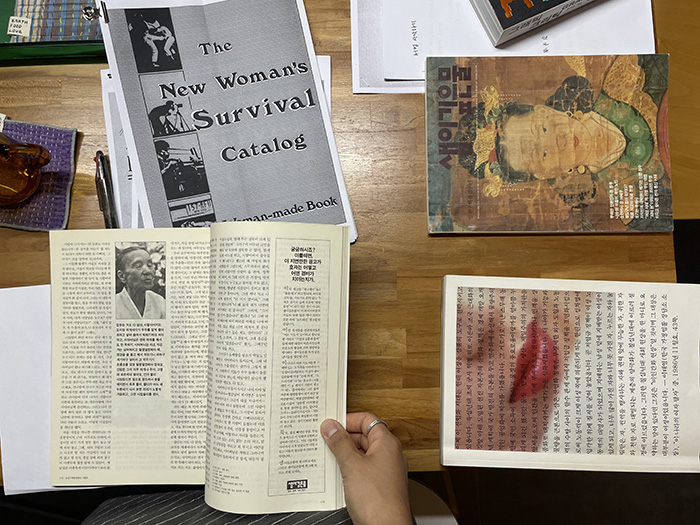
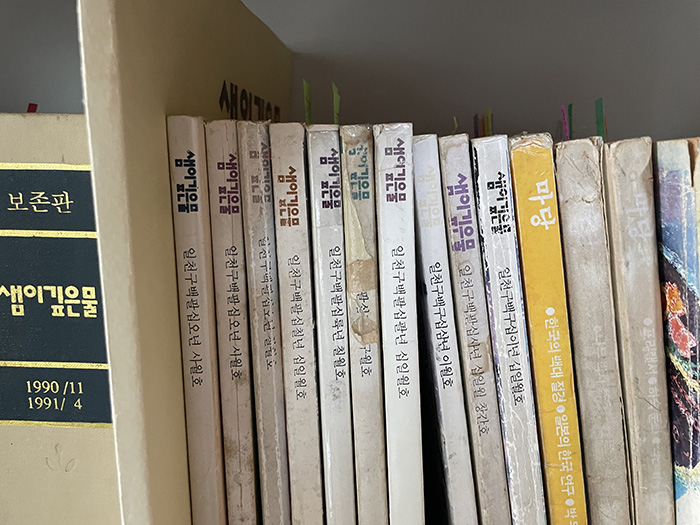
Later, in August 2025, I had the opportunity to meet Kay Jun (Jeon Ga-gyung), a design critic, writer, and designer based in Korea. I contacted her because I knew she had been archiving Korean feminist magazines from the 1980s and 1990s and had recently published a book2 on feminist graphism from that period. During our conversation, she shared materials related to feminist publications and women’s movements from the 1980s.

She also introduced me to several archives, including the Korea Democracy Foundation (KDF) Open Archive and the Another Culture Archive.3 These contain a wide range of feminist zines and magazines that can be freely accessed. What first caught my attention was the diversity of their forms, from illustrations and layouts to editorial structures and textual voices.

Kay encouraged me to explore these materials further, noting that most research on feminist publications in Korea focuses on historical or literary perspectives, with little attention to their visual and graphic dimensions. She suggested that reading these materials through their graphic language could offer a new way of understanding how women appear within the visual mechanisms of activism. After returning from Korea, I read several of her essays on feminist graphic design in the 1980s.

I then felt drawn to translate these texts from Korean into English, as a way of sharing them and opening up conversations across languages. Through this process, I was also introduced to prominent Western women poets and writers from others. Such as Diane di Prima, Anne Carson, Bernadette Mayer. The more I encountered these writers, the more curious I became about feminist literature in Korea. I found myself reading and researching it more closely, which eventually led me to the work of contemporary feminist Korean poet Kim Hyesoon.

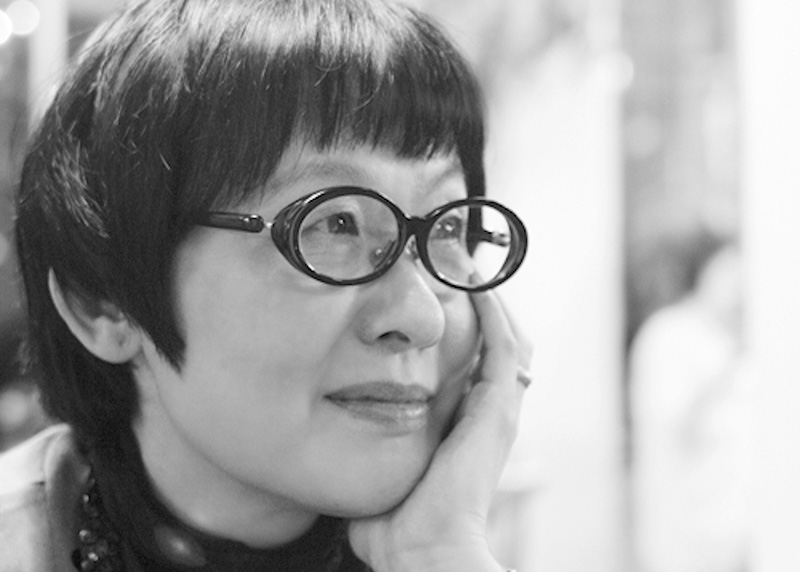
Kim Hyesoon (b.1955) is one of the most prominent contemporary poets in Korea, whose work confronts the histories of oppression women have endured through her distinctive poetic language. Her poetry often begins from deeply Korean experiences of womanhood — the devoted wife, the enduring housewife — and pushes against them,4 expanding the possibilities of gender equality through resistance. At the same time, Kim has long resisted the tendency to confine women poets within the reductive category of “women’s poetry,” a label often imposed within literary spaces historically dominated by men.5 Yet she continues to believe in its potential — in the voices that women have cultivated through histories of gender discrimination, and in the ways those voices continue to grow and transform.

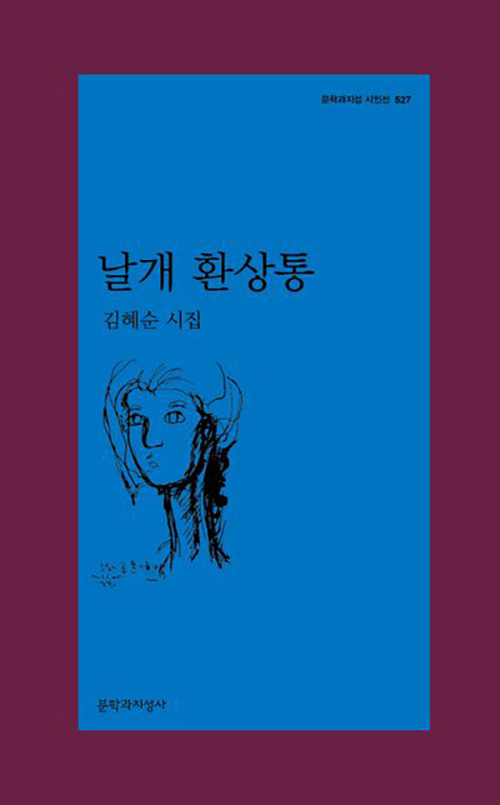
Kim’s collection of poems, Autobiography of Death (2016), translated into English by Don Mee Choi, received the Griffin Poetry Prize in 2019, marking the first time a Korean poet received the prize. Another collection, Phantom Pain Wings (2019), also translated by Choi, won the National Book Critics Circle Award for poetry in 2024 — the first time a translated poetry collection received the award in the category’s history. Rooted in Korean cultural contexts and often described as carrying a shamanistic intensity,6 Kim’s poetry resonates far beyond Korea, speaking to experiences many women recognise, such as unequal domestic labour, domestic violence, and everyday gendered oppression.

When I first bought Autobiography of Death, I turned to the interview with her translator, Don Mee Choi. In that conversation, Kim says, “women’s language is a language of death. The body of a woman poet is a form of text, but it is a text of the deaf, mute, and blind. That is because the mother tongue sits on men’s tongues.” She goes on to describe women’s writing as emerging from a place of anonymity and absence, in contrast to masculine writing that is structured, assertive, and historically preserved.7

In other words, women’s writing is positioned as marginal, voiceless, and difficult to articulate within dominant language systems. Reading this helped me understand how women’s writing and voices are situated in Korean literature – something that had previously felt vague to me.

2. Kay Jun, Graphic Critique: Hangeul Typography, Publishing, and Activism Since the 1970s(Seoul: Ahn Graphics, 2025).

3. Korea Democracy Foundation, “Open Archive,” Another Culture Archive.

4. Jeong Myeong Kyo, “Korean Literature Today in the Context of World Literature and Translation,” Comparative Korean Studies 21, no. 2 (2013): 33.

5. Sung Hyunah. “The Study of Femininity in the English Translations of Kim Hyesoon’s Poetry.” Feminism and Korean Literature, no. 63 (2024): 112.

6. Ibid., 113.

7. Kim Hyesoon, Autobiography of Death (New York: New Directions, 2018), 100.

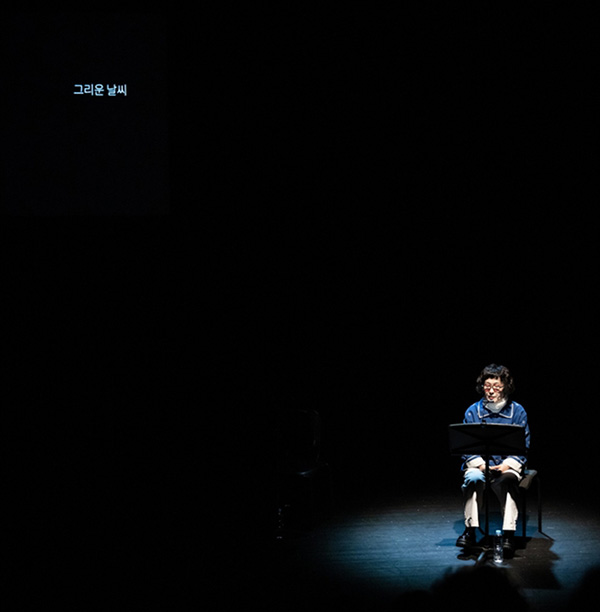
↓ Kim reading her poem
Chapter 3 image 1
Chapter 3 image 2
Chapter 3 image 3
Chapter 3 image 4
Chapter 3 image 5
Chapter 3 image 6

Chapter 3

Missing vs. Vanished

I had mainly translated texts with a more academic tone, focusing on making Korean theoretical materials more accessible. However, after encountering Kim’s rich and complex language, I decided to turn to translating poetry — to see how my voice might emerge differently in this context. I translated some of her poems from Korean into English myself, even though English translations already existed. Translation became a way of entering her poetic world more deeply, slowing down my reading and attending to each word and line.

Of course, my translations were far from professional. I often struggled to choose the right words, and at times I was not even sure whether I fully understood the original poem. Translating poetry is especially difficult because Korean and English differ structurally in important ways. In Korean, sentences can make sense without explicitly stating the subject, creating ambiguity about who or what is being referred to. In English, however, the subject usually needs to be specified, which often required me to make interpretive decisions. Despite these difficulties, the process was meaningful. Through translating, I felt more closely connected to Kim’s writing, almost as if I were becoming her student.

After completing my translations, I compared them with the published versions by Don Mee Choi. In doing so, I did not treat Choi’s translation as an answer key, but as another interpretation of the same poem. The variations were often striking. At times, we chose entirely different words for the same line, each reflecting a different way of reading the poem.

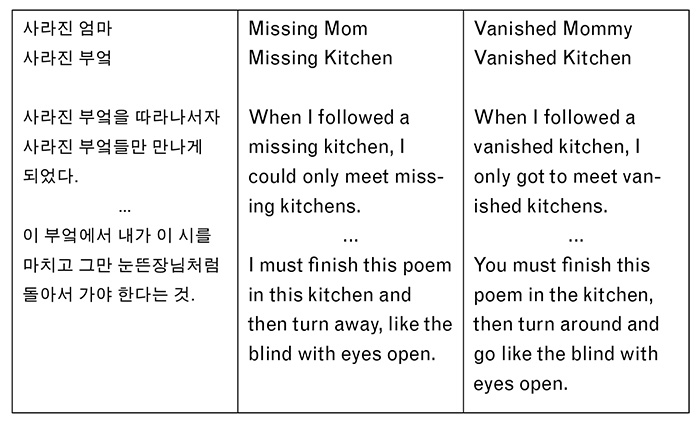
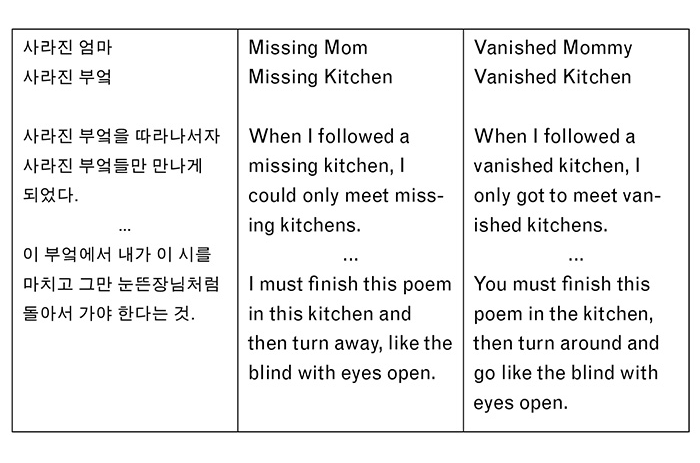
For example (Fig. 1), in one poem8 I translated a word as “missing,” while Choi used “vanished.” In another line, where I placed the subject as “I,” she chose “you.” Both translations are grammatically correct, and the overall meaning remains intact. Yet these small differences shift the tone and emotional atmosphere of the poem.

“Missing” implies disappearance in relation to someone. It suggests that someone is still searching, leaving open the possibility of return. The absent figure remains within a network of relationships, carrying a sense of connection and expectation.

“Vanished,” by contrast, suggests a complete disappearance without a trace. It implies a break from the world itself, where the act of searching becomes meaningless.

In the poem, the “vanished kitchen” and the “vanished mother” do not promise a return. The kitchen is even compared to a dead person, raising the question of whether it knows it will never come back. If translated as “missing,” the meaning may still hold, but it risks softening the poem’s intensity by suggesting the possibility of return. The unsettling finality of “vanished” is replaced by a more relational and emotional tone.

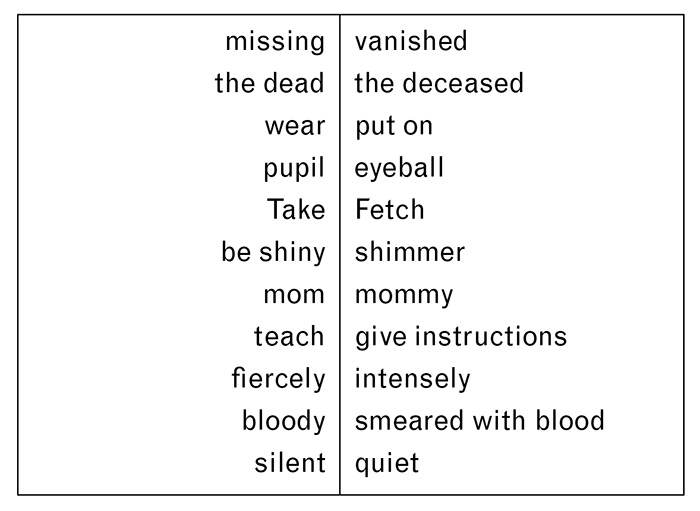
Differences in word choice (Fig. 2) felt unexpectedly inspiring. They made me realise that translation is not simply a mechanical replacement between languages, but a process of interpretation that can shift meaning, tone, and emotional intensity. Each choice reshapes the poem.

Translation, therefore, is not about establishing a one-to-one correspondence between languages. As Walter Benjamin suggests, the translator’s task is to release what he calls “pure language” through re-creation.9 This “pure language” can be understood as the singularity of the original — what makes the text itself.10 In this sense, translation does not diminish the original, but allows it to unfold, giving form to what was already there.

By layering three voices – Kim’s original poem, Choi’s translation, and my own – I could see how a poem changes as it moves through different bodies, histories, places, and generations.

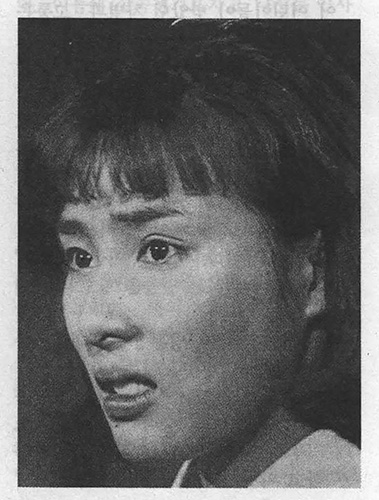
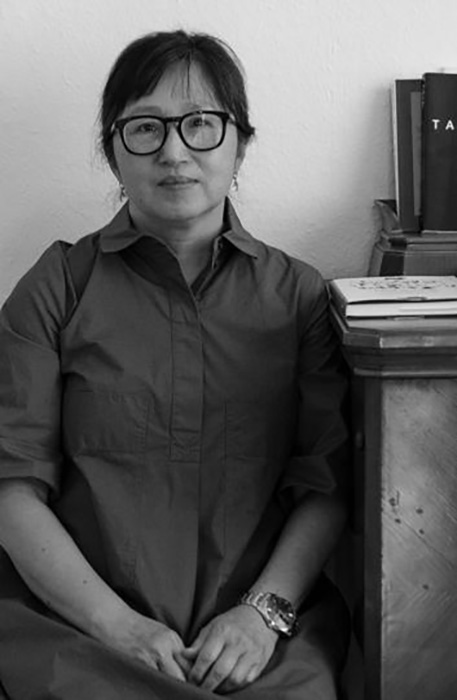
Don Mee Choi (b.1962) is a Korean-born poet and translator who has introduced Kim’s poetry to the English-speaking world for more than two decades. Their collaboration is often described as one of the most significant poet–translator partnerships in contemporary Korean literature.11 Choi describes her translation practice as anti-neocolonial12 — a form of resistance against linguistic and cultural domination — shaped by what she calls “geopolitical poetics,”13 a mode of writing that brings together history, race, migration, and resistance to dominant narratives.

After immigrating to the United States, Choi gradually lost her mother tongue and was unable to speak or write for a long time. It was through translating Kim’s poetry that she began to recover her voice, describing her tongue as that of a wanderer — a tongue of exile.14 Translation became not only a movement between languages, but also a way of reclaiming linguistic and poetic identity, where language is experienced as “linguistic illegitimacy” and spoken as an “orphan tongue.”15

Reading Choi’s diary entries16 made me reflect on the limits of equivalence in translation. In Postwoman, for example, Kim lists Korean particles in a dense sequence, such as “은는이가 / 을를에의 / 와과만도,” which Choi renders as “isareambe / inonatof / andwithonlytoo.” These are not exact equivalents but loose approximations, showing how even the smallest grammatical elements can become difficult and sometimes torturous choices17 This led me to ask what a flawless translation could mean, and whether translation can ever be judged simply as right or wrong.

8. Kim Hyesoon, “Sarinjin Eomma Sarinjin Bueok” [사라진 엄마 사라진 부엌], in Nalgae Hwansangtong [날개환상통] (Seoul: Munhakgwa Jisungsa, 2019), 202–4.

9. Walter Benjamin, “The Task of the Translator,” in Illuminations, trans. Harry Zohn (New York: Schocken Books, 1968), 80.

10. Cho Jaeryong, Beonyeokhaneun Munjangdeul [번역하는 문장들] (Seoul: Munhakgwa Jisungsa, 2015), 58.

11. Bruce Fulton, “Review of Sorrowtoothpaste Mirrorcream, by Kim Hyesoon,” Tulsa Studies in Women’s Literature 34, no. 2 (2015): 456.

12. Don Mee Choi, Translation Is a Mode = Translation Is an Anti-Neocolonial Mode (New York: Ugly Duckling Presse, 2020), 3.

13. Don Mee Choi, Hardly War (London: And Other Stories, 2025), 4.

14. Kim Eun-hyung, “K Literature’s BTS-like Pair: Kim Hyesoon and Don Mee Choi in Conversation,” Hankyoreh, September 25, 2022.

15. Gloria Anzaldúa, “How to Tame a Wild Tongue,” in Borderlands/La Frontera: The New Mestiza (San Francisco: Aunt Lute Books, 1987), 58. Here I refer to Gloria Anzaldúa’s concept of linguistic border conditions, in which speakers experience what she describes as “linguistic illegitimacy” and speak in what she calls an “orphan tongue,” reflecting a sense of displacement across languages and identities.

16. Kim Hyesoon, Phantom Pain Wings (London: And Other Stories, 2024), 170–82.

17. Ibid., 175.

↓ Scanned image from “Samikipunmul”
Chapter 4 image 1
Chapter 4 image 2

Chapter 4

Beyond Equivalence

For a long time, I believed my translations were poor in quality. However, as the research progressed, I realised that translation does not have one single correct form. What matters is how a translator approaches the original text, as each inevitably brings their own histories, experiences, and positionalities into the process.

In her translator’s diary, Choi writes that she sometimes replicates Korean syntax in English — not because it improves the sentence, but because it opens another possibility, another language.18 Rather than producing a single correct version, translation becomes a way of creating new possibilities of language.

I initially translated texts to share them with others and make them more accessible. But I soon realised that translation also had something to do with myself. Through translating, I came to ask: what kinds of feminist and political voices can emerge through my practice? In a context where speaking as a feminist is still often considered radical in Korea, I wonder how translating women’s poetry might contribute to reshaping perceptions of feminism.

18. Ibid., 173.

fig. 1. Archive scan, 1994
Chapter 5 image 1
Chapter 5 image 2
Chapter 5 image 3
Chapter 5 image 4

Chapter 5

From the Archive

The question of how feminist voices could emerge through translation led me beyond poetry and toward the material histories that surround it. This became another phase of my research: working with feminist publication archives.

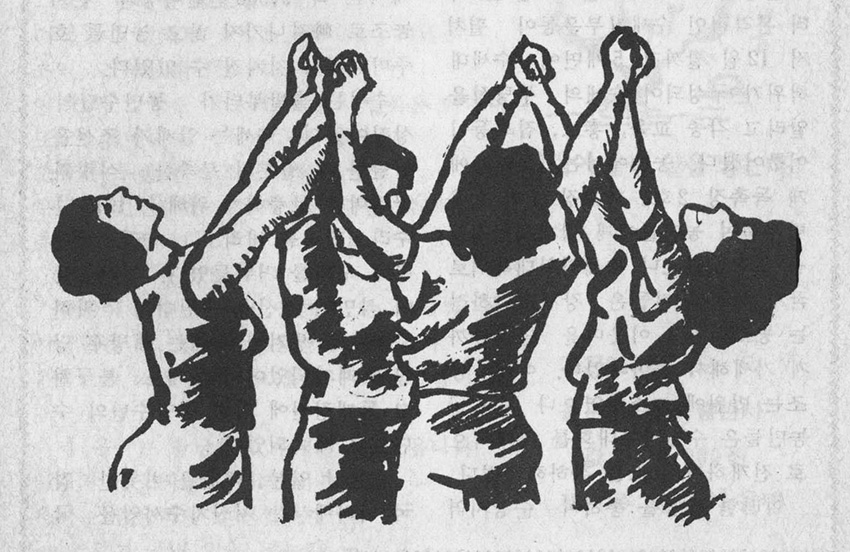
In August 2025, when Kay introduced me to Korean feminist publication archives such as the KDF Open Archive and the Another Culture Archive, I began exploring them almost immediately. What struck me most was the richness of their visual language – woodcut prints, brush-written titles, calligraphic lettering, documentary photographs, and humorous drawings. These images are not only aesthetically compelling but also convey the immediacy of struggle, depicting harsh working conditions and the persistence of women’s resistance.

Although originally produced alongside texts, slogans, and testimonies, they are powerful enough to stand on their own. Read in this way, they function as visual essays, carrying their own narrative voice.

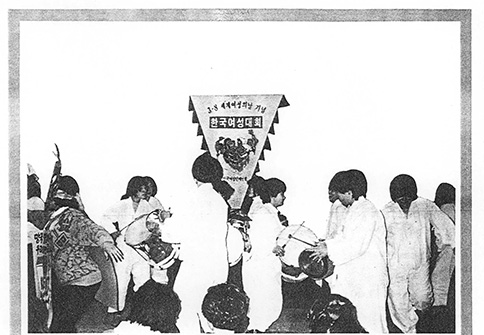
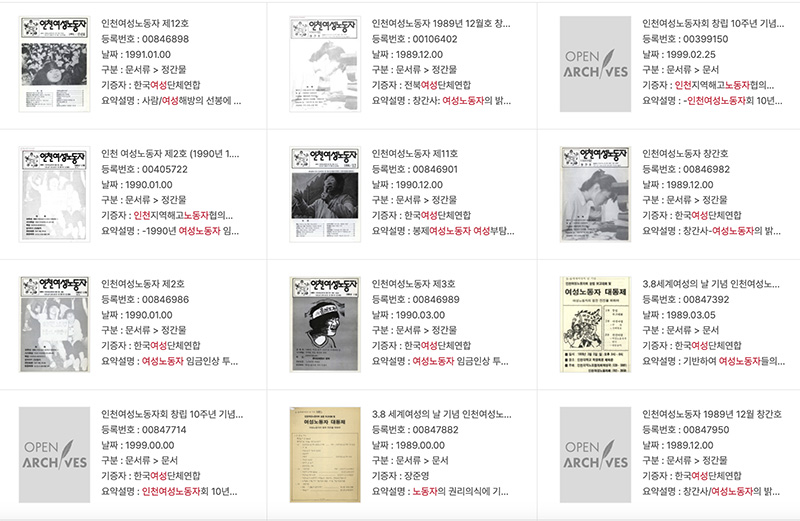
The KDF Open Archive preserves materials related to South Korea’s democratisation movements, making them publicly accessible. Among its collections, I focused on materials from the women’s movement of the 1980s and 1990s, when publishing and democratisation movements closely reinforced one another.19 Print became a key method for building collective consciousness and mobilising women politically. For example, women used both textual and visual forms to carry and circulate the aims of the movement and its on-the-ground realities.

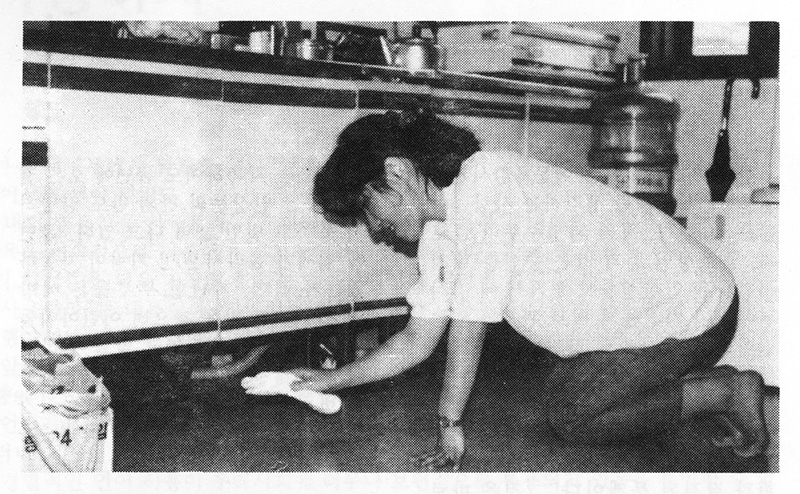
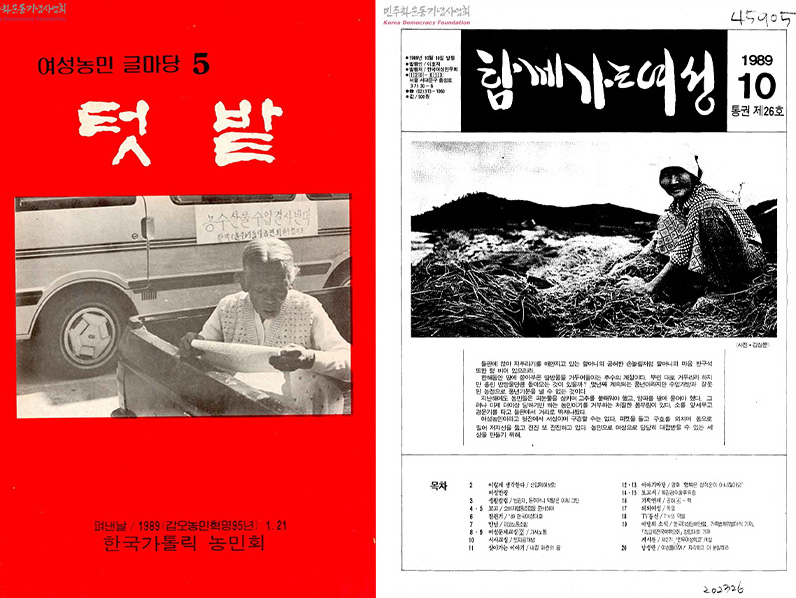
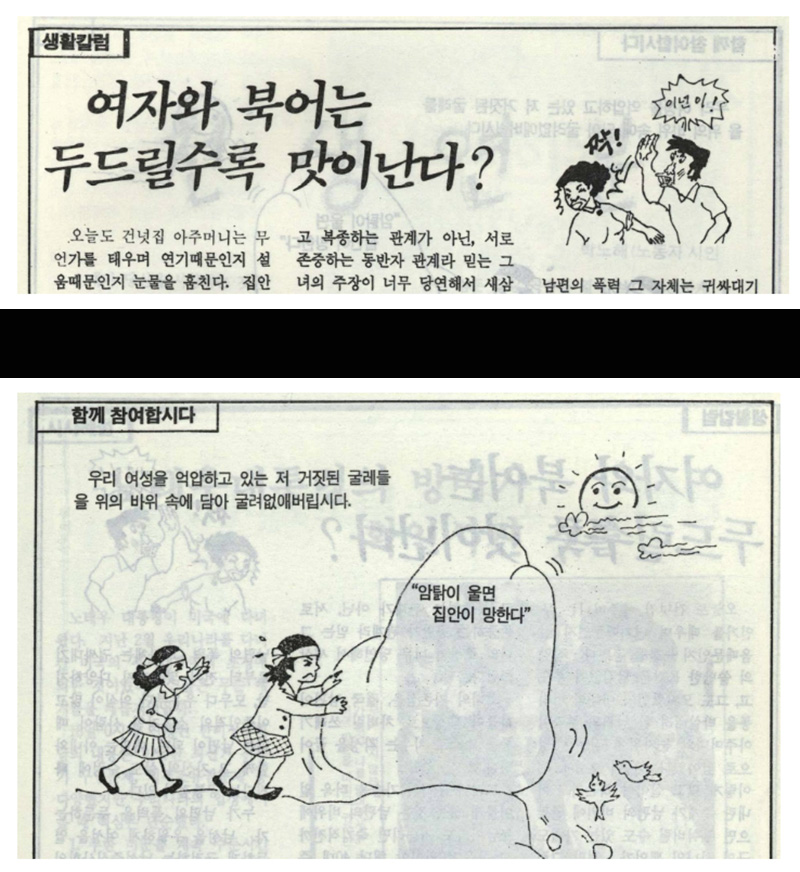
Most of these materials take the form of newsletters, bulletins, or flyers — ephemera produced under limited resources. Yet they vividly record women’s lives at the intersection of poverty, dictatorship, and gender oppression. Publications such as Hamkke Ganeun Yeoseong [함께 가는 여성] (1987), Teotbat [텃밭] (1987), and Incheon Yeoseong Nodongja [인천여성노동자] (Figs. 3–4) make visible the lives of ordinary Korean women, largely absent from male-dominated media.20 Through photographs, comics, and illustrations, these publications construct a distinct visual language of feminist resistance.

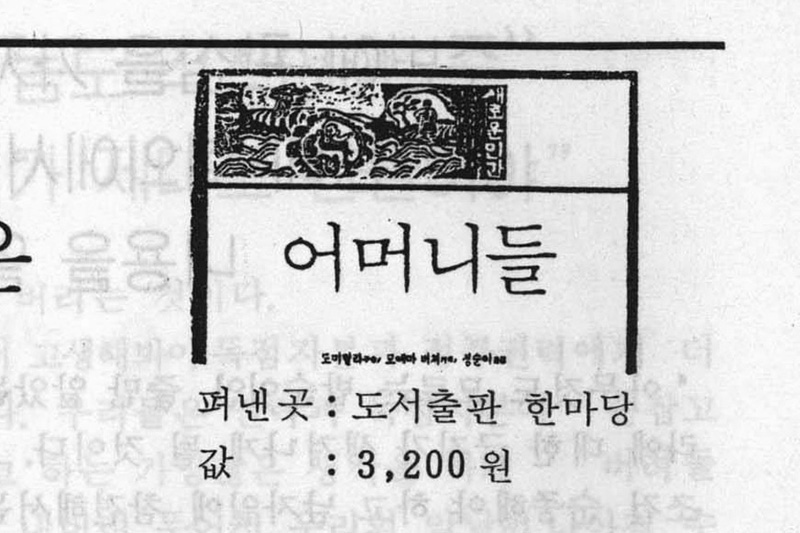
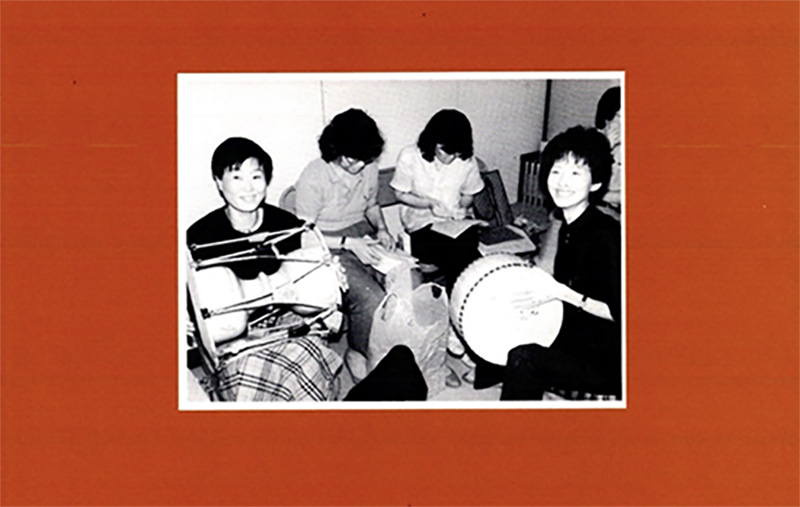
Another important archive, Another Culture, shares similarities with these materials while developing a distinct approach. Formed in 1984, the collective published a mook (a hybrid of magazine and book) from 1985 onward. Unlike most printed materials, which functioned as tools of activism, publishing itself became central to their practice. Kim Hyesoon was also a member of this collective, contributing poems and essays.

19. Lee Joong-han et al., Uri Chulpan 100-nyeon [우리 출판 100년] (Seoul: Hyeonamsa, 2001), 280.

20. Kay Jun, Graphic Critic, 470.

fig. 1. Archive scan, 1994
Chapter 6 image 1
Chapter 6 image 2
Chapter 6 image 3
Chapter 6 image 4
Chapter 6 image 5

Chapter 6

Poetry and Image in Dialogue

I continued reading and translating Kim’s poems while returning to the two archives, collecting visual materials along the way. I noticed points of resonance between the poems and the archival materials. I placed them side by side, treating the poems as textual reflections of reality and the archive materials as their visual counterparts.

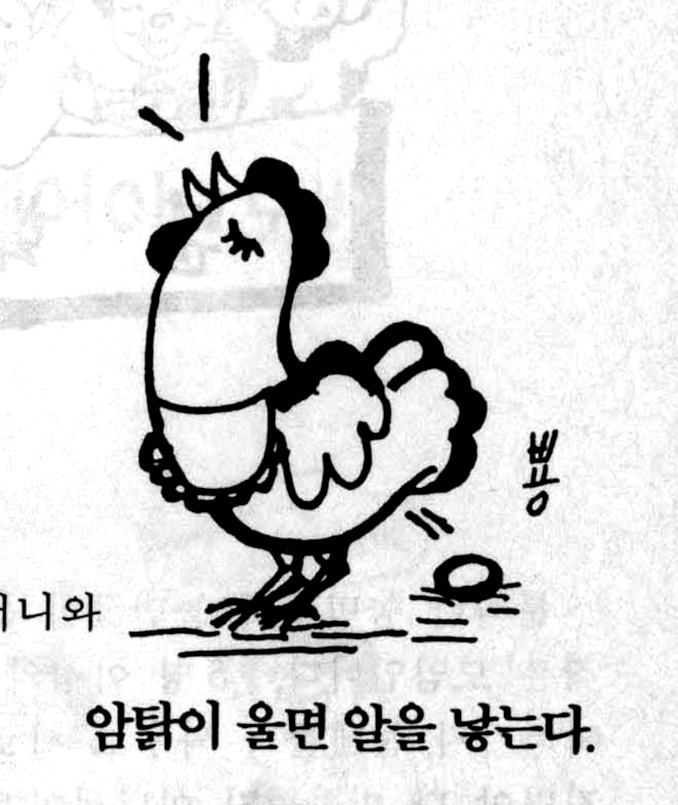
In Bragging About My Dress,21 Kim writes: “The saying that when a dress cries three times the whole nation goes under is also a lie,” “The saying that you must beat your dress every three days is a lie,” and “The saying that the plates break when three dresses get together is a lie.” These lines echo well-known Korean proverbs — “When a hen crows three times, the whole household is ruined,” “Women and dried pollock must be beaten every three days,” and “Plates break when three women gather together” — sayings that normalise misogyny and discipline women’s voices and behaviour. Though they may sound outdated, they continue to linger in everyday language.

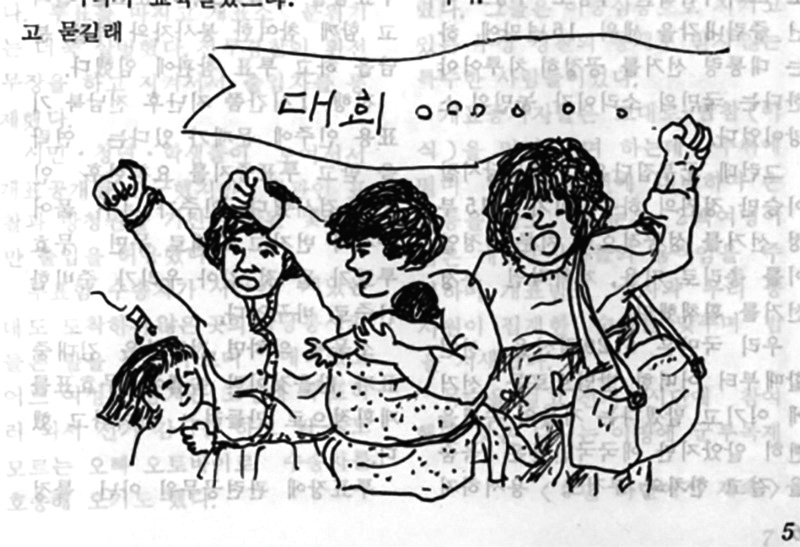
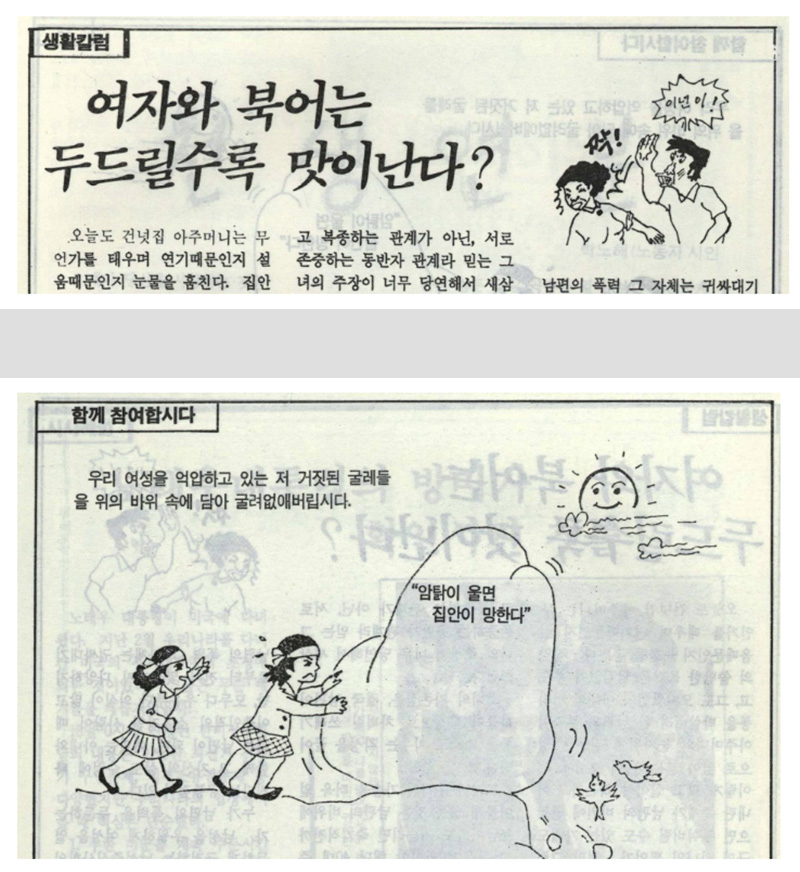
Similar metaphors also appear in feminist publications from the KDF Open Archive. For instance, Incheon Yeoseong Nodongja includes a column titled “Does a Woman and Dried Pollock Taste Better When Beaten?”22 (Fig. 5) which exposes domestic violence and argues for women’s recognition as subjects of their own lives. In the same issue, a simple drawing (Fig. 6) of two women pushing a large rock is accompanied by the phrase “When a hen crows, the household is ruined,” alongside the call to gather and overturn the structures that oppress women.

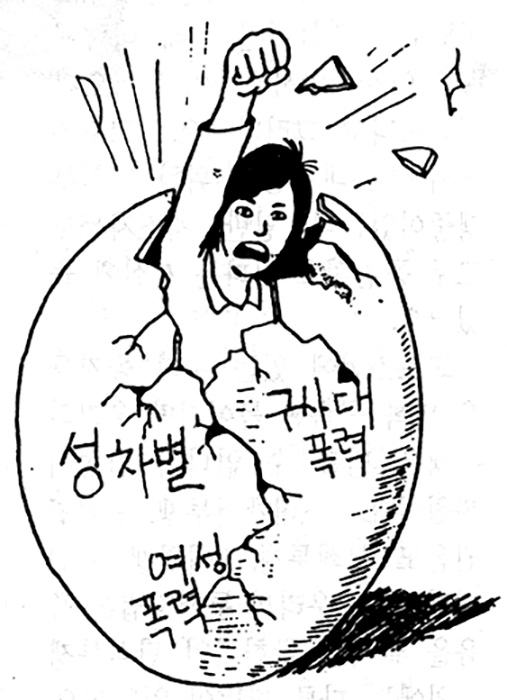
Kim likewise traces the realities of domestic violence and its internalisation in her poetry. In Lord No,23 she writes: “You live with him who slaps your mommy’s back … That you fall asleep with Lord No who shouts, Earn your keep!” These patriarchal conditions appear not only in poetry but also in the archives. In Incheon Yeoseong Nodongja, for instance, there is an article titled “Let’s Expel Indiscriminate Violence Against Women.”24 accompanied by an illustration (Fig. 7) of a woman breaking out of an eggshell labeled “sexism,” “violence against women,” and “old-fashioned violence.”

If read only through aesthetic or genre-based criteria, such images risk being dismissed as merely illustrative. Instead, they should be understood as a form of graphic language. The image of a woman breaking out of the shell presents a figure of agency and transformation, while the handwritten words inscribed onto it make visible the social conditions women were struggling against. By combining image and text, these publications communicate complex realities in a direct and powerful way.

Seeing these parallels made me realise that the realities in Kim’s poetry are not isolated literary expressions, but are deeply connected to the material conditions documented in feminist publications. Translation is not only a linguistic act, but also a way of moving between forms — between text and image, poetry and archive. This realisation shaped my approach to the project. Rather than treating translation as a self-contained process, I brought poems and archival images into dialogue, allowing them to speak to one another and expand how these feminist histories can be read and understood. As Kay notes, documenting and sustaining diverse representations of women remains a crucial task within feminist practice.25

21. Kim Hyesoon, Phantom Pain Wings, 145–46.

22. Incheon Yeoseong Nodongja Preparatory Issue, no. 0 (November 15, 1989), 15.

23. Kim Hyesoon, Autobiography of Death, 59–60.

24. Incheon Yeoseong Nodongja, no. 9 (September 10, 1990), 4.

25. Kay Jun, Graphic Critique, 471.

fig. 1. Archive scan, 1994
Chapter 7 image 1
Chapter 7 image 2
Chapter 7 image 3

Chapter 7

Towards a Beginning

This research on Korean women’s poetry and feminist publications remains at an early stage, even as it draws from a rich body of materials. I hope this work can serve as a starting point — a small contribution to the discourse around feminist design and women’s poetry in Korea.

Feminist publications and women’s literature have often been overlooked despite their significance. Addressing this absence is part of a broader task in Korean design history — to uncover and bring to light materials that have long remained buried.26

This project has asked how translation in Korean women’s poetry, alongside feminist publication archives approached as visual material, can contribute to reshaping perceptions of feminism in Korea. Through this research, it became clear that the field remains underdeveloped. The limited introduction of Don Mee Choi in Korea, and the absence of Korean translations of her poetry collections, suggest that research on Korean women’s poetry has yet to expand in multiple directions. Likewise, although open archives are increasingly accessible, studies that approach feminist imagery as an independent visual language are only beginning to emerge.

For this reason, engaging with these questions may require time and sustained effort. Still, I believe that each small act of research can become part of a larger movement. What now appears as fragments may, in retrospect, come together as a more collective shift.

I end with a passage by the Korean feminist scholar Oh Sook-hee from the late 1980s:

“In the 1980s, the conditions of the women’s movement clearly changed. […] Who, then, are the women who remain within the major tasks of the 1990s? They are not a distant group, but each and every one of us. The future of the women’s movement — how it develops and what force it holds — depends on the attitudes we carry as women living in this society. History belongs to those who participate in it.”27

26. Ibid., 13.

27. Oh Sukhee, “The Achievements of the Women’s Movement in the 1980s: We Have Barely Found Our Way,” Saemikipunmul, December 1989, 52–53.

Bibliography

Anzaldúa, Gloria. “How to Tame a Wild Tongue.” InBorderlands/La Frontera: The New Mestiza. San Francisco: Aunt Lute Books, 1987.

Benjamin, Walter. “The Task of the Translator.” InIlluminations. Translated by Harry Zohn. New York: Schocken Books, 1968.

Choi, Don Mee. Hardly War. London: And Other Stories, 2025.

———. Translation Is a Mode = Translation Is an Anti-Neocolonial Mode. New York: Ugly Duckling Presse, 2020.

Cho, Jaeryong. Beonyeokhaneun Munjangdeul [번역하는 문장들]. Seoul: Munhakgwa Jisungsa, 2015.

Fulton, Bruce. “Review of Sorrowtoothpaste Mirrorcream, by Kim Hyesoon.” ulsa Studies in Women’s Literature 34, no. 2 (2015): 456.

Jeong, Myeong Kyo. “Korean Literature Today in the Context of World Literature and Translation.” Comparative Korean Studies 21, no. 2 (2013): 11–37.

Jun, Kay. Graphic Critique: Hangeul Typography, Publishing, and Activism Since the 1970s. Seoul: Ahn Graphics, 2025.

Kim, Eun-hyung. “K Literature’s BTS-like Pair: Kim Hyesoon and Don Mee Choi in Conversation.” Hankyoreh. September 25, 2022. https://www.hani.co.kr/arti/culture/book/1060028.html

Kim, Hyesoon. Autobiography of Death. New York: New Directions, 2018.

———. Nalgae Hwansangtong [날개 환상통]. Seoul: Munhakgwa Jisungsa, 2019.

———. Phantom Pain Wings. London: And Other Stories, 2024.

Korea Democracy Foundation. “Open Archive.” Accessed March 10, 2026. https://archives.kdemo.or.kr/main

Another Culture Archive. Accessed March 10, 2026. https://www.archivecenter.net/tomoon1984/archive/ArchiveIntro.do

Lee, Joong-han, et al. Uri Chulpan 100-nyeon [우리 출판 100년]. Seoul: Hyeonamsa, 2001.

Oh, Sukhee. “The Achievements of the Women’s Movement in the 1980s: We Have Barely Found Our Way.” Saemikipunmul. December 1989.

Sullivan, Elizabeth. “Carol Seajay, Old Wives Tales and the Feminist Bookstore Network.” FoundSF. October 14, 1976. https://www.foundsf.org/Carol_Seajay,_Old_Wives_Tales_and_the_Feminist_Bookstore_Network

Sung, Hyunah. “The Study of Femininity in the English Translations of Kim Hyesoon’s Poetry.” Feminism and Korean Literature, no. 63 (2024): 109–48.

Incheon Yeoseong Nodongja. No. 9. September 10, 1990. Incheon: Incheon Women Workers Association.

Incheon Yeoseong Nodongja Preparatory Issue. No. 0. November 15, 1989. Incheon: Incheon Women Workers Association.
Colophon

Women–Poetry–Translation
: Rewriting Feminist Voices across Text and Archive


BA Thesis
Graphic Design Department
Royal Academy of Art, The Hague
April 2026

Writing guided by Barbara Neves Alves

Website guided by Thomas Buxó and François Girard-Meunier

Proofreading by Jin O.

Thanks to
Kim Hyesoon, Kay Jun, Haeun Na, Jin O., Mia You, Don Mee Choi, Phil Baber, and Felix Salut.

Design & Development
Jaehyun Kim

Typeface
Baskerville Neo
Monotype Grotesque

1. Elizabeth Sullivan, “Carol Seajay, Old Wives Tales and the Feminist Bookstore Network,” FoundSF, October 14, 1976.

2. Kay Jun, Graphic Critique: Hangeul Typography, Publishing, and Activism Since the 1970s(Seoul: Ahn Graphics, 2025).

3. Korea Democracy Foundation, “Open Archive,” Another Culture Archive.

4. Jeong Myeong Kyo, “Korean Literature Today in the Context of World Literature and Translation,” Comparative Korean Studies 21, no. 2 (2013): 33.

5. Sung Hyunah. “The Study of Femininity in the English Translations of Kim Hyesoon’s Poetry.” Feminism and Korean Literature, no. 63 (2024): 112.

6. Ibid., 113.

7. Kim Hyesoon, Autobiography of Death (New York: New Directions, 2018), 100.

8. Kim Hyesoon, “Sarinjin Eomma Sarinjin Bueok” [사라진 엄마 사라진 부엌], in Nalgae Hwansangtong [날개환상통] (Seoul: Munhakgwa Jisungsa, 2019), 202–4.

9. Walter Benjamin, “The Task of the Translator,” in Illuminations, trans. Harry Zohn (New York: Schocken Books, 1968), 80.

10. Cho Jaeryong, Beonyeokhaneun Munjangdeul [번역하는 문장들] (Seoul: Munhakgwa Jisungsa, 2015), 58.

11. Bruce Fulton, “Review of Sorrowtoothpaste Mirrorcream, by Kim Hyesoon,” Tulsa Studies in Women’s Literature 34, no. 2 (2015): 456.

12. Don Mee Choi, Translation Is a Mode = Translation Is an Anti-Neocolonial Mode (New York: Ugly Duckling Presse, 2020), 3.

13. Don Mee Choi, Hardly War (London: And Other Stories, 2025), 4.

14. Kim Eun-hyung, “K Literature’s BTS-like Pair: Kim Hyesoon and Don Mee Choi in Conversation,” Hankyoreh, September 25, 2022.

15. Gloria Anzaldúa, “How to Tame a Wild Tongue,” in Borderlands/La Frontera: The New Mestiza (San Francisco: Aunt Lute Books, 1987), 58. Here I refer to Gloria Anzaldúa’s concept of linguistic border conditions, in which speakers experience what she describes as “linguistic illegitimacy” and speak in what she calls an “orphan tongue,” reflecting a sense of displacement across languages and identities.

16. Kim Hyesoon, Phantom Pain Wings (London: And Other Stories, 2024), 170–82.

17. Ibid., 175.

18. Ibid., 173.

19. Lee Joong-han et al., Uri Chulpan 100-nyeon [우리 출판 100년] (Seoul: Hyeonamsa, 2001), 280.

20. Kay Jun, Graphic Critic, 470.

21. Kim Hyesoon, Phantom Pain Wings, 145–46.

22. Incheon Yeoseong Nodongja Preparatory Issue, no. 0 (November 15, 1989), 15.

23. Kim Hyesoon, Autobiography of Death, 59–60.

24. Incheon Yeoseong Nodongja, no. 9 (September 10, 1990), 4.

25. Kay Jun, Graphic Critique, 471.

26. Ibid., 13.

27. Oh Sukhee, “The Achievements of the Women’s Movement in the 1980s: We Have Barely Found Our Way,” Saemikipunmul, December 1989, 52–53.

1. Example footnote text goes here.

2. Another note can go here.

Women–Poetry–Translation:
Rewriting Feminist Voices
across Text and Archive

Jaehyun Kim


Scroll down

Contents

Chapter 0

Abstract

Chapter 0 image 1
↑ Image from the KDF Open Archive

This research follows a translating journey through women’s voices, Korean feminist histories, and imperfect and interpretive translations, while attending to visual traces of women that have yet to be fully seen.

Focusing on the poetry of Korean feminist poet Kim Hyesoon and its English translations by Don Mee Choi, the study compares my own translations with Choi’s to examine how differences in word choice and grammatical structure shift meaning, tone, and emotional intensity, revealing the limits of equivalence in translation.

Chapter 0 image 2
↑ Image from the KDF Open Archive

It also explores feminist print materials from the 1980s and 1990s in the Korea Democracy Foundation (KDF) Open Archive, analysing their visual language, including illustrations, photographs, and graphic compositions. These materials are understood not only as historical records of publishing as a central force in the women’s movement, but also as visual forms that vividly represent women’s lives and convey the aspirations and conditions of feminist struggle at the time.

By bringing poems and archival images into dialogue, the study identifies connections between literary and visual expressions, suggesting that the realities in Kim Hyesoon’s poetry are closely tied to the material conditions documented in feminist publications.

Ultimately, translation is understood as a practice that moves across languages, media, and histories, opening up multiple ways of reading feminist narratives and contributing to discussions on feminist representation and visual culture in Korea.

Chapter 0 image 3
↑ Image from the KDF Open Archive

Keywords
women’s poetry, Kim Hyesoon, Don Mee Choi, translation, feminism, Korean women’s movement (1980s–1990s), women’s oppression, feminist publishing archives

Chapter 1

The First Encounter

Chapter 1 image 1
↑ Carol Seajay’s “Feminist Bookstore News” newsletter

In 2025, during my third-year typography class, we were asked to transcribe an interview conducted by the writer and oral historian Suzanne Snider with women involved in feminist print activism. Each student typeset the interview in their own way. I chose an interview with Carol Seajay, co-founder of the feminist bookstore Old Wives Tales in San Francisco and editor of the newsletter Feminist Bookstore News until its closure in 2000.1

This was my first real encounter with the idea of a feminist bookstore. I was struck by the existence of a space created by women and for women, filled with feminist publications. It was not simply a bookstore, but a meeting point for feminist communities, activism, and knowledge.

Chapter 1 image 2
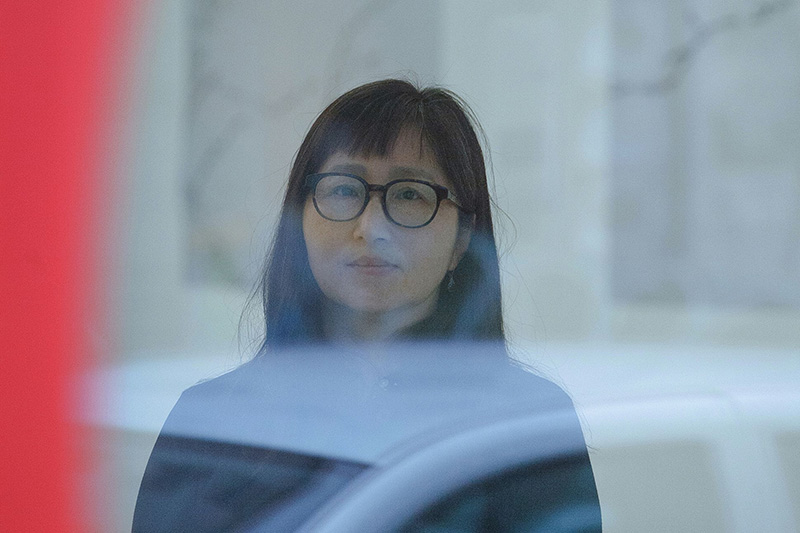
↑ Carol Seajay (left)

The interview was nearly three hours long. Listening to Carol speak about feminist publishing felt deeply valuable. I wanted to share these stories with people in Korea, so I decided to translate the interview from English into Korean. It was my first attempt at translation. The process was demanding, but also genuinely rewarding. Through translation, I followed her life more closely and imagined these histories traveling across linguistic and cultural contexts.

Chapter 2

Entering Feminist Texts

Chapter 2 image 1
↑ Meeting with Kay in Daegu, South Korea, August 2025

Later, in August 2025, I had the opportunity to meet Kay Jun (Jeon Ga-gyung), a design critic, writer, and designer based in Korea. I contacted her because I knew she had been archiving Korean feminist magazines from the 1980s and 1990s and had recently published a book2 on feminist graphism from that period. During our conversation, she shared materials related to feminist publications and women’s movements from the 1980s.

She also introduced me to several archives, including the Korea Democracy Foundation (KDF) Open Archive and the Another Culture Archive.3 These contain a wide range of feminist zines and magazines that can be freely accessed. What first caught my attention was the diversity of their forms, from illustrations and layouts to editorial structures and textual voices.

Chapter 2 image 2
↑ Issues of “Saemikipunmul” magazine from Kay’s collection

Kay encouraged me to explore these materials further, noting that most research on feminist publications in Korea focuses on historical or literary perspectives, with little attention to their visual and graphic dimensions. She suggested that reading these materials through their graphic language could offer a new way of understanding how women appear within the visual mechanisms of activism. After returning from Korea, I read several of her essays on feminist graphic design in the 1980s.

I then felt drawn to translate these texts from Korean into English, as a way of sharing them and opening up conversations across languages. Through this process, I was also introduced to prominent Western women poets and writers from others. Such as Diane di Prima, Anne Carson, Bernadette Mayer. The more I encountered these writers, the more curious I became about feminist literature in Korea. I found myself reading and researching it more closely, which eventually led me to the work of contemporary feminist Korean poet Kim Hyesoon.

Chapter 2 image 3
↑ Kim Hyesoon

Kim Hyesoon (b.1955) is one of the most prominent contemporary poets in Korea, whose work confronts the histories of oppression women have endured through her distinctive poetic language. Her poetry often begins from deeply Korean experiences of womanhood — the devoted wife, the enduring housewife — and pushes against them,4 expanding the possibilities of gender equality through resistance. At the same time, Kim has long resisted the tendency to confine women poets within the reductive category of “women’s poetry,” a label often imposed within literary spaces historically dominated by men.5 Yet she continues to believe in its potential — in the voices that women have cultivated through histories of gender discrimination, and in the ways those voices continue to grow and transform.

Chapter 2 image 4
↑ The original Korean edition of Kim’s “Phantom Pain Wings”

Kim’s collection of poems, Autobiography of Death (2016), translated into English by Don Mee Choi, received the Griffin Poetry Prize in 2019, marking the first time a Korean poet received the prize. Another collection, Phantom Pain Wings (2019), also translated by Choi, won the National Book Critics Circle Award for poetry in 2024 — the first time a translated poetry collection received the award in the category’s history. Rooted in Korean cultural contexts and often described as carrying a shamanistic intensity,6 Kim’s poetry resonates far beyond Korea, speaking to experiences many women recognise, such as unequal domestic labour, domestic violence, and everyday gendered oppression.

Chapter 2 image 4
↑ Kim reading her poem aloud

When I first bought Autobiography of Death, I turned to the interview with her translator, Don Mee Choi. In that conversation, Kim says, “women’s language is a language of death. The body of a woman poet is a form of text, but it is a text of the deaf, mute, and blind. That is because the mother tongue sits on men’s tongues.” She goes on to describe women’s writing as emerging from a place of anonymity and absence, in contrast to masculine writing that is structured, assertive, and historically preserved.7

In other words, women’s writing is positioned as marginal, voiceless, and difficult to articulate within dominant language systems. Reading this helped me understand how women’s writing and voices are situated in Korean literature – something that had previously felt vague to me.

Chapter 3

Missing vs. Vanished

Chapter 3 image 1
↑ Image from the KDF Open Archive

I had mainly translated texts with a more academic tone, focusing on making Korean theoretical materials more accessible. However, after encountering Kim’s rich and complex language, I decided to turn to tranlating poetry — to see how my voice might emerge differently in this context. I translated some of her poems from Korean into English myself, even though English translations already existed. Translation became a way of entering her poetic world more deeply, slowing down my reading and attending to each word and line.

Chapter 3 image 2
↑ Image from the KDF Open Archive

Of course, my translations were far from professional. I often struggled to choose the right words, and at times I was not even sure whether I fully understood the original poem. Translating poetry is especially difficult because Korean and English differ structurally in important ways. In Korean, sentences can make sense without explicitly stating the subject, creating ambiguity about who or what is being referred to. In English, however, the subject usually needs to be specified, which often required me to make interpretive decisions. Despite these difficulties, the process was meaningful. Through translating, I felt more closely connected to Kim’s writing, almost as if I were becoming her student.

Chapter 3 image 3
Fig. 1. Original text by Kim Hyesoon (left), with translations by Jaehyun Kim (middle) and Don Mee Choi (right).

After completing my translations, I compared them with the published versions by Don Mee Choi. In doing so, I did not treat Choi’s translation as an answer key, but as another interpretation of the same poem. The variations were often striking. At times, we chose entirely different words for the same line, each reflecting a different way of reading the poem.

For example (Fig. 1), in one poem8 I translated a word as “missing,” while Choi used “vanished.” In another line, where I placed the subject as “I,” she chose “you.” Both translations are grammatically correct, and the overall meaning remains intact. Yet these small differences shift the tone and emotional atmosphere of the poem.

“Missing” implies disappearance in relation to someone. It suggests that someone is still searching, leaving open the possibility of return. The absent figure remains within a network of relationships, carrying a sense of connection and expectation.

“Vanished,” by contrast, suggests a complete disappearance without a trace. It implies a break from the world itself, where the act of searching becomes meaningless.

In the poem, the “vanished kitchen” and the “vanished mother” do not promise a return. The kitchen is even compared to a dead person, raising the question of whether it knows it will never come back. If translated as “missing,” the meaning may still hold, but it risks softening the poem’s intensity by suggesting the possibility of return. The unsettling finality of “vanished” is replaced by a more relational and emotional tone.

Chapter 3 image 4
Fig. 2. Two wordlists used by Jaehyun Kim (left) and Don Mee Choi (right).

Differences in word choice (Fig. 2) felt unexpectedly inspiring. They made me realise that translation is not simply a mechanical replacement between languages, but a process of interpretation that can shift meaning, tone, and emotional intensity. Each choice reshapes the poem.

Translation, therefore, is not about establishing a one-to-one correspondence between languages. As Walter Benjamin suggests, the translator’s task is to release what he calls “pure language” through re-creation.9 This “pure language” can be understood as the singularity of the original — what makes the text itself.10 In this sense, translation does not diminish the original, but allows it to unfold, giving form to what was already there.

Chapter 3 image 5
↑ Don Mee Choi

By layering three voices – Kim’s original poem, Choi’s translation, and my own – I could see how a poem changes as it moves through different bodies, histories, places, and generations.

Don Mee Choi (b.1962) is a Korean-born poet and translator who has introduced Kim’s poetry to the English-speaking world for more than two decades. Their collaboration is often described as one of the most significant poet–
translator partnerships in contemporary Korean literature.11
Choi describes her translation practice as anti-neocolonial12 — a form of resistance against linguistic and cultural domination — shaped by what she calls “geopolitical poetics,”13 a mode of writing that brings together history, race, migration, and resistance to dominant narratives.

Chapter 3 image 6
↑ Don Mee Choi

After immigrating to the United States, Choi gradually lost her mother tongue and was unable to speak or write for a long time. It was through translating Kim’s poetry that she began to recover her voice, describing her tongue as that of a wanderer — a tongue of exile.14 Translation became not only a movement between languages, but also a way of reclaiming linguistic and poetic identity, where language is experienced as “linguistic illegitimacy” and spoken as an “orphan tongue.”15

Reading Choi’s diary entries16 made me reflect on the limits of equivalence in translation. In Postwoman, for example, Kim lists Korean particles in a dense sequence, such as “은는이가 / 을를에의 / 와과만도,” which Choi renders as “isareambe / inonatof / andwithonlytoo.” These are not exact equivalents but loose approximations, showing how even the smallest grammatical elements can become difficult and sometimes torturous choices17 This led me to ask what a flawless translation could mean, and whether translation can ever be judged simply as right or wrong.

Chapter 4

Beyond Equivalence

Chapter 4 image 1
↑ Cropped advertisement image from “Saemikipunmul” magazine (source: Kay Jun, “Phototext in ‘Saemikipunmul’”)

For a long time, I believed my translations were poor in quality. However, as the research progressed, I realised that translation does not have one single correct form. What matters is how a translator approaches the original text, as each inevitably brings their own histories, experiences, and positionalities into the process.

In her translator’s diary, Choi writes that she sometimes replicates Korean syntax in English — not because it improves the sentence, but because it opens another possibility, another language.18 Rather than producing a single correct version, translation becomes a way of creating new possibilities of language.

Chapter 4 image 2
↑ Image from Another Culture Archive

I initially translated texts to share them with others and make them more accessible. But I soon realised that translation also had something to do with myself. Through translating, I came to ask: what kinds of feminist and political voices can emerge through my practice? In a context where speaking as a feminist is still often considered radical in Korea, I wonder how translating women’s poetry might contribute to reshaping perceptions of feminism.

Chapter 5

From the Archive

Chapter 5 image 1
↑ Image from the KDF Open Archive

The question of how feminist voices could emerge through translation led me beyond poetry and toward the material histories that surround it. This became another phase of my research: working with feminist publication archives.

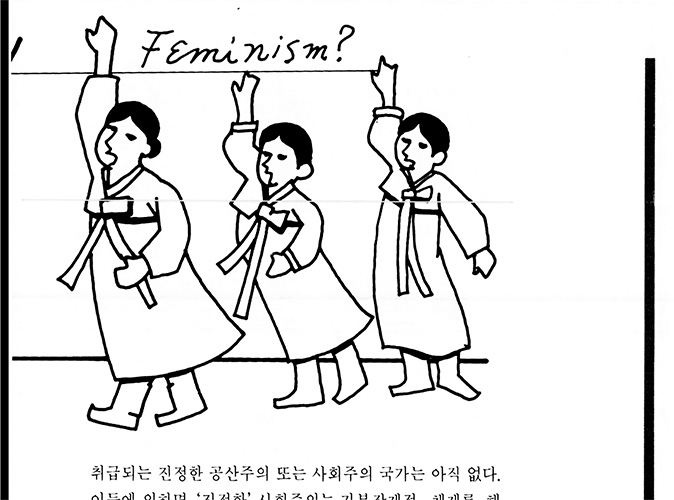
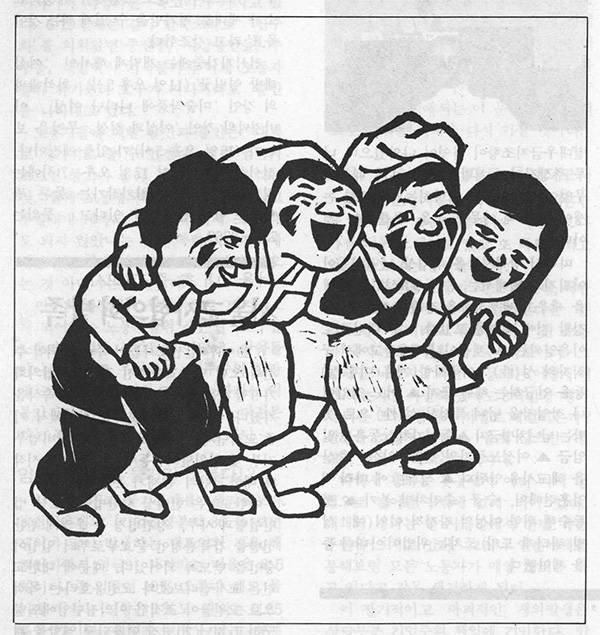
In August 2025, when Kay introduced me to Korean feminist publication archives such as the KDF Open Archive and the Another Culture Archive, I began exploring them almost immediately. What struck me most was the richness of their visual language – woodcut prints, brush-written titles, calligraphic lettering, documentary photographs, and humorous drawings. These images are not only aesthetically compelling but also convey the immediacy of struggle, depicting harsh working conditions and the persistence of women’s resistance.

Chapter 5 image 2
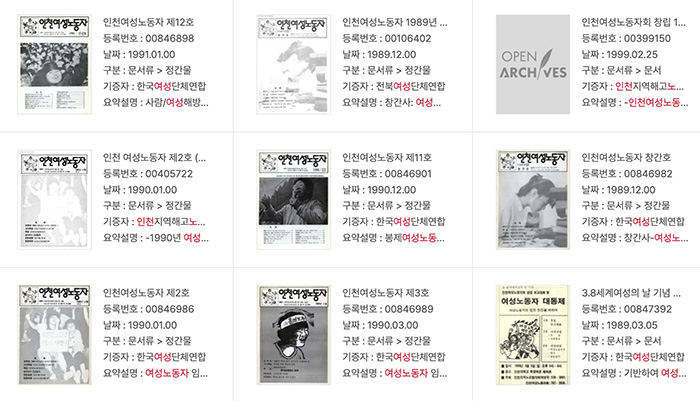
↑ Screenshot from the KDF Open Archive website

Although originally produced alongside texts, slogans, and testimonies, they are powerful enough to stand on their own. Read in this way, they function as visual essays, carrying their own narrative voice.

The KDF Open Archive preserves materials related to South Korea’s democratisation movements, making them publicly accessible. Among its collections, I focused on materials from the women’s movement of the 1980s and 1990s, when publishing and democratisation movements closely reinforced one another.19 Print became a key method for building collective consciousness and mobilising women politically. For example, women used both textual and visual forms to carry and circulate the aims of the movement and its on-the-ground realities.

Chapter 5 image 3
Figs. 3–4. “Teotbat” (left) and “Hamkke Ganeun Yeoseong” (right)

Most of these materials take the form of newsletters, bulletins, or flyers — ephemera produced under limited resources. Yet they vividly record women’s lives at the intersection of poverty, dictatorship, and gender oppression. Publications such as Hamkke Ganeun Yeoseong [함께 가는 여성] (1987), Teotbat [텃밭] (1987), and Incheon Yeoseong Nodongja [인천여성노동자] (Figs. 3–4) make visible the lives of ordinary Korean women, largely absent from male-dominated media.20 Through photographs, comics, and illustrations, these publications construct a distinct visual language of feminist resistance.

Chapter 5 image 4
↑ Image from the mook “Another Culture”

Another important archive, Another Culture, shares similarities with these materials while developing a distinct approach. Formed in 1984, the collective published a mook (a hybrid of magazine and book) from 1985 onward. Unlike most printed materials, which functioned as tools of activism, publishing itself became central to their practice. Kim Hyesoon was also a member of this collective, contributing poems and essays.

Chapter 6

Poetry and Image in Dialogue

Chapter 6 image 1
↑ Image from the KDF Open Archive

I continued reading and translating Kim’s poems while returning to the two archives, collecting visual materials along the way. I noticed points of resonance between the poems and the archival materials. I placed them side by side, treating the poems as textual reflections of reality and the archive materials as their visual counterparts.

Chapter 6 image 2
↑ Image from the KDF Open Archive

In Bragging About My Dress,21 Kim writes: “The saying that when a dress cries three times the whole nation goes under is also a lie,” “The saying that you must beat your dress every three days is a lie,” and “The saying that the plates break when three dresses get together is a lie.” These lines echo well-
known Korean proverbs — “When a hen crows three times, the whole household is ruined,” “Women and dried pollock must be beaten every three days,” and “Plates break when three women gather together” — sayings that normalise misogyny and discipline women’s voices and behaviour. Though they may sound outdated, they continue to linger in everyday language.

Chapter 6 image 3
Figs. 5–6. Illustration from “Incheon Yeoseong Nodongja”

Similar metaphors also appear in feminist publications from the KDF Open Archive. For instance, Incheon Yeoseong Nodongja includes a column titled “Does a Woman and Dried Pollock Taste Better When Beaten?”22 (Fig. 5) which exposes domestic violence and argues for women’s recognition as subjects of their own lives. In the same issue, a simple drawing (Fig. 6) of two women pushing a large rock is accompanied by the phrase “When a hen crows, the household is ruined,” alongside the call to gather and overturn the structures that oppress women.

Chapter 6 image 4
Fig. 7. Illustration from “Incheon Yeoseong Nodongja”

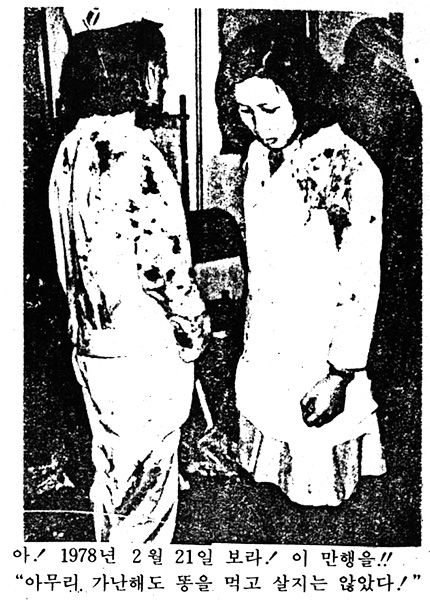
Kim likewise traces the realities of domestic violence and its internalisation in her poetry. In Lord No,23 she writes: “You live with him who slaps your mommy’s back … That you fall asleep with Lord No who shouts, Earn your keep!” These patriarchal conditions appear not only in poetry but also in the archives. In Incheon Yeoseong Nodongja, for instance, there is an article titled “Let’s Expel Indiscriminate Violence Against Women.”24 accompanied by an illustration (Fig. 7) of a woman breaking out of an eggshell labeled “sexism,” “violence against women,” and “old-fashioned violence.”

Chapter 6 image 5
↑ Image from the KDF Open Archive

If read only through aesthetic or genre-
based criteria, such images risk being dismissed as merely illustrative. Instead, they should be understood as a form of graphic language. The image of a woman breaking out of the shell presents a figure of agency and transformation, while the handwritten words inscribed onto it make visible the social conditions women were struggling against. By combining image and text, these publications communicate complex realities in a direct and powerful way.

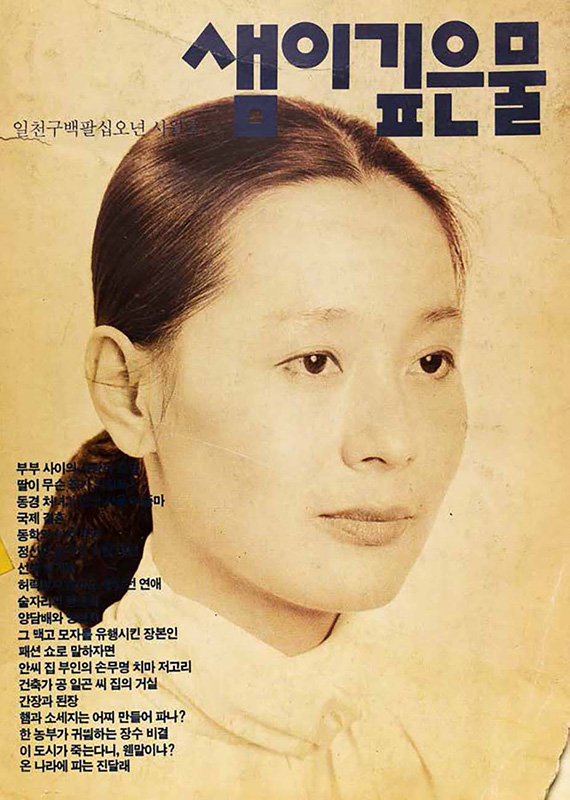
Seeing these parallels made me realise that the realities in Kim’s poetry are not isolated literary expressions, but are deeply connected to the material conditions documented in feminist publications. Translation is not only a linguistic act, but also a way of moving between forms — between text and image, poetry and archive. This realisation shaped my approach to the project. Rather than treating translation as a self-contained process, I brought poems and archival images into dialogue, allowing them to speak to one another and expand how these feminist histories can be read and understood. As Kay notes, documenting and sustaining diverse representations of women remains a crucial task within feminist practice.25

Chapter 7

Towards a Beginning

Chapter 7 image 1
↑ Image from the mook “Another Culture”

This research on Korean women’s poetry and feminist publications remains at an early stage, even as it draws from a rich body of materials. I hope this work can serve as a starting point — a small contribution to the discourse around feminist design and women’s poetry in Korea.

Feminist publications and women’s literature have often been overlooked despite their significance. Addressing this absence is part of a broader task in Korean design history — to uncover and bring to light materials that have long remained buried.26

Chapter 7 image 2
↑ Image from the KDF Open Archive

This project has asked how translation in Korean women’s poetry, alongside feminist publication archives approached as visual material, can contribute to reshaping perceptions of feminism in Korea. Through this research, it became clear that the field remains underdeveloped. The limited introduction of Don Mee Choi in Korea, and the absence of Korean translations of her poetry collections, suggest that research on Korean women’s poetry has yet to expand in multiple directions. Likewise, although open archives are increasingly accessible, studies that approach feminist imagery as an independent visual language are only beginning to emerge.

Chapter 7 image 3
↑ Cover of “Saemikipunmul” (October 1985)

For this reason, engaging with these questions may require time and sustained effort. Still, I believe that each small act of research can become part of a larger movement. What now appears as fragments may, in retrospect, come together as a more collective shift.

I end with a passage by the Korean feminist scholar Oh Sook-hee from the late 1980s:

“In the 1980s, the conditions of the women’s movement clearly changed. […] Who, then, are the women who remain within the major tasks of the 1990s? They are not a distant group, but each and every one of us. The future of the women’s movement — how it develops and what force it holds — depends on the attitudes we carry as women living in this society. History belongs to those who participate in it.”27

Bibliography

Anzaldúa, Gloria. “How to Tame a Wild Tongue.” In Borderlands/La Frontera: The New Mestiza. San Francisco: Aunt Lute Books, 1987.

Benjamin, Walter. “The Task of the Translator.” In Illuminations. Translated by Harry Zohn. New York: Schocken Books, 1968.

Choi, Don Mee. Hardly War. London: And Other Stories, 2025.

———. Translation Is a Mode = Translation Is an Anti-Neocolonial Mode. New York: Ugly Duckling Presse, 2020.

Cho, Jaeryong. Beonyeokhaneun Munjangdeul [번역하는 문장들]. Seoul: Munhakgwa Jisungsa, 2015.

Fulton, Bruce. “Review of Sorrowtoothpaste Mirrorcream, by Kim Hyesoon.” Tulsa Studies in Women’s Literature 34, no. 2 (2015): 456.

Jeong, Myeong Kyo. “Korean Literature Today in the Context of World Literature and Translation.” Comparative Korean Studies 21, no. 2 (2013): 11–37.

Jun, Kay. Graphic Critique: Hangeul Typography, Publishing, and Activism Since the 1970s. Seoul: Ahn Graphics, 2025.

Kim, Eun-hyung. “K Literature’s BTS-like Pair: Kim Hyesoon and Don Mee Choi in Conversation.” Hankyoreh. September 25, 2022. https://www.hani.co.kr/arti/culture/book/1060028.html

Kim, Hyesoon. Autobiography of Death. New York: New Directions, 2018.

———. Nalgae Hwansangtong [날개 환상통]. Seoul: Munhakgwa Jisungsa, 2019.

———. Phantom Pain Wings. London: And Other Stories, 2024.

Korea Democracy Foundation. “Open Archive.” Accessed March 10, 2026. https://archives.kdemo.or.kr/main

Another Culture Archive. Accessed March 10, 2026. https://www.archivecenter.net/tomoon1984/archive/ArchiveIntro.do

Lee, Joong-han, et al. Uri Chulpan 100-nyeon [우리 출판 100년]. Seoul: Hyeonamsa, 2001.

Oh, Sukhee. “The Achievements of the Women’s Movement in the 1980s: We Have Barely Found Our Way.” Saemikipunmul. December 1989.

Sullivan, Elizabeth. “Carol Seajay, Old Wives Tales and the Feminist Bookstore Network.” FoundSF. October 14, 1976.https://www.foundsf.org/Carol_Seajay,_Old_Wives_Tales_and_the_Feminist_Bookstore_Network

Sung, Hyunah. “The Study of Femininity in the English Translations of Kim Hyesoon’s Poetry.” Feminism and Korean Literature, no. 63 (2024): 109–48.

Incheon Yeoseong Nodongja. No. 9. September 10, 1990. Incheon: Incheon Women Workers Association.

Incheon Yeoseong Nodongja Preparatory Issue. No. 0. November 15, 1989. Incheon: Incheon Women Workers Association.
Colophon

Women–Poetry–Translation
: Rewriting Feminist Voices across
Text and Archive


BA Thesis
Graphic Design Department
Royal Academy of Art, The Hague
April 2026

Writing guided by
Barbara Neves Alves

Website guided by
Thomas Buxó and François Girard-Meunier

Proofreading by Jin O.

Thanks to Kim
Kim Hyesoon, Kay Jun, Haeun Na, Jin O., Mia You, Don Mee Choi, Phil Baber, and Felix Salut.

Design & Development
Jaehyun Kim

Typeface
Baskerville Neo
Monotype Grotesque