Abstract
This project investigates how contemporary media environments shape the way information is encountered and processed, focusing on the tension between rapid consumption and meaningful engagement. Sparked by the hollow experience of “mindless scrolling,” it asks how design can intervene in systems that value speed and accumulation over actual reflection.
Drawing on the work of media theorist Neil Postman and philosopher Friedrich Nietzsche, the project explores engagement with information as a metabolic act – one that requires breaking down, absorbing, and, crucially, discarding content. Through design-led inquiry, the work mirrors three phases of digestion: fragmentation, metabolism, and elimination. In dialogue with the practices of artists Priscila Fernandes and Marina Abramović, and designers Silvio Lorusso, and Sebastian Schmieg, the project examines how form shapes the conditions of attention – how the presentation of information and the way in which it is encountered determines whether engagement is dispersed and hurried or sustained and reflective.
Through the research a design method of transformation emerges; where the ‘at-a-glance’ legibility of everyday commercial graphics is repurposed to frame denser, more substantive fragments of content that are usually buried in complexity. While the familiar form promises effortless intake, the nuance of the content resists immediate comprehension. By creating a deliberate lag between the moment of looking and of understanding, the work exposes passive habits of consumption and positions design as a tool for active, intentional engagement.
Introduction
I mutter, chuckling at my own meme reference as I swipe past a TikTok video drowning in text. Approximately three seconds into the next clip, the reflex registers. I had just encountered something that would have taken maybe ten seconds to engage with, yet I dismissed it instantly in favour of something faster, more effortless.
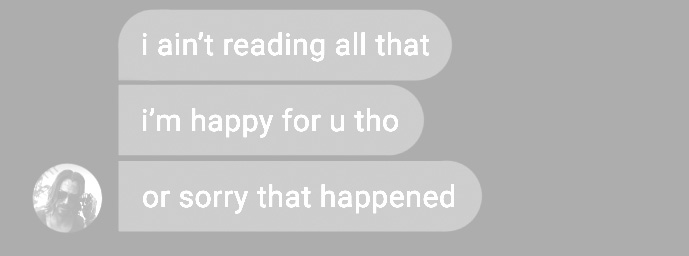

I recognise that I am scrolling toward a state of fulfilment that never arrives, stopping only when a vague sense of exhaustion kicks in. In chasing easy intake, I have trained myself to avoid the very effort required for fulfilling engagement, leaving me with a steady stream of information that fails to foster any kind of reflection.
This project examines the space where speed and excess undermine reflection – where information is no longer a form of nourishment, but a product of optimisation. While optimisation prioritises volume and ease of consumption, nourishment requires the time and attention necessary for an idea to be absorbed and carried forward. I propose looking at this tension through an embodied lens: treating the mind as a digestive system that requires selection, duration, and transformation to truly internalise what it takes in.
This metabolic model of thinking is not new; philosopher Friedrich Nietzsche famously invoked digestion as a metaphor for the labour of thought, emphasising the need to process and “chew” ideas rather than merely swallow them whole. Within this framework, I propose interruption, pause, and resistance as ways of disrupting seamless loops of information consumption. I describe these moments of disruption as forms of friction, and explore them as a strategy enabling deeper reflection and engagement.
In my practice, I navigate this condition by deconstructing my own notes and intuitive drawings into concentrated fragments, stripping them from the continuous flow to test their endurance. By allowing design to dictate the rhythm of the encounter, I align my work with the critiques of practitioners like Portuguese artist Priscila Fernandes and Italian writer and designer Silvio Lorusso. Through their work and my own, I explore how we might move from a state of constant intake to a deliberate practice of mental digestion.
Background
I read 1984 when I was fourteen, and George Orwell’s dystopian vision of a society in which individual freedom is suppressed through surveillance, control of information, and enforced conformity left a lingering sense of unease. The novel depicts a world where truth is constantly rewritten and independent thought is discouraged, leaving little room for personal agency. Since reading the book, I have been wary of the parallels between the world described in this literary classic and contemporary society – where information is increasingly shaped by media systems that influence what we see and believe. Because of this, my attention was immediately caught when I encountered the following passage in Amusing Ourselves to Death, a 1985 book by media theorist Neil Postman:
“Orwell warns that we will be overcome by an externally imposed oppression. But in Huxley's vision, no Big Brother is required to deprive people of their autonomy, maturity and history. As he saw it, people will come to love their oppression, to adore the technologies that undo their capacities to think.”
Postman’s warning of a society that grows to love the same technologies that strip away its capacity for thought haunts me as I think of all the times I have scrolled past content that would require deeper engagement than half a glance and a chuckle. Here, he is referring to Aldous Huxley’s Brave New World, a dystopian vision comparable to Orwell’s 1984, but achieved through fundamentally different means. In 1984, control is enforced through censorship and fear, with authority imposed from above. In contrast, Brave New World presents a society where control operates through pleasure, distraction, and constant stimulation. Rather than being oppressed, people are pacified; kept content enough to not question the systems that shape their lives.
In Amusing Ourselves to Death, Postman compares Huxley’s vision to contemporary society, warning that communication and information systems that prioritise entertainment over reflection create “present-centred mediums.” These platforms deliver fragmented information without context or continuity, focusing on present events. Today, this dynamic is amplified by algorithm-driven feeds, breaking news notifications, and short-form videos that surface isolated moments without broader context.
Postman argues that this sort of rapid-fire delivery leaves no room for evaluation; we move so quickly from one snippet to the next that the act of collecting information overtakes the act of actually processing it – digesting it.
This idea prompted me to centre the metaphor of digestion in this project, both as a critique of mindless intake and as a design method. By treating the mind as a digestive system, I approach information as something that must be broken down, absorbed, or rejected. Through a process of design-led inquiry, I test how form can influence this “metabolic” process. The following sections trace this approach in three phases: breaking information into bites, metabolising it through reflection, and discarding what cannot be meaningfully absorbed.
PHASE I
Breaking Into Bites
I pause the audiobook. Rewind a few seconds. A sentence caught my attention, though I’m not sure why. I let it play again, scrawling a few words down before they slip past. The impulse to continue listening – to move on and stay in the flow – is still there, but I resist.
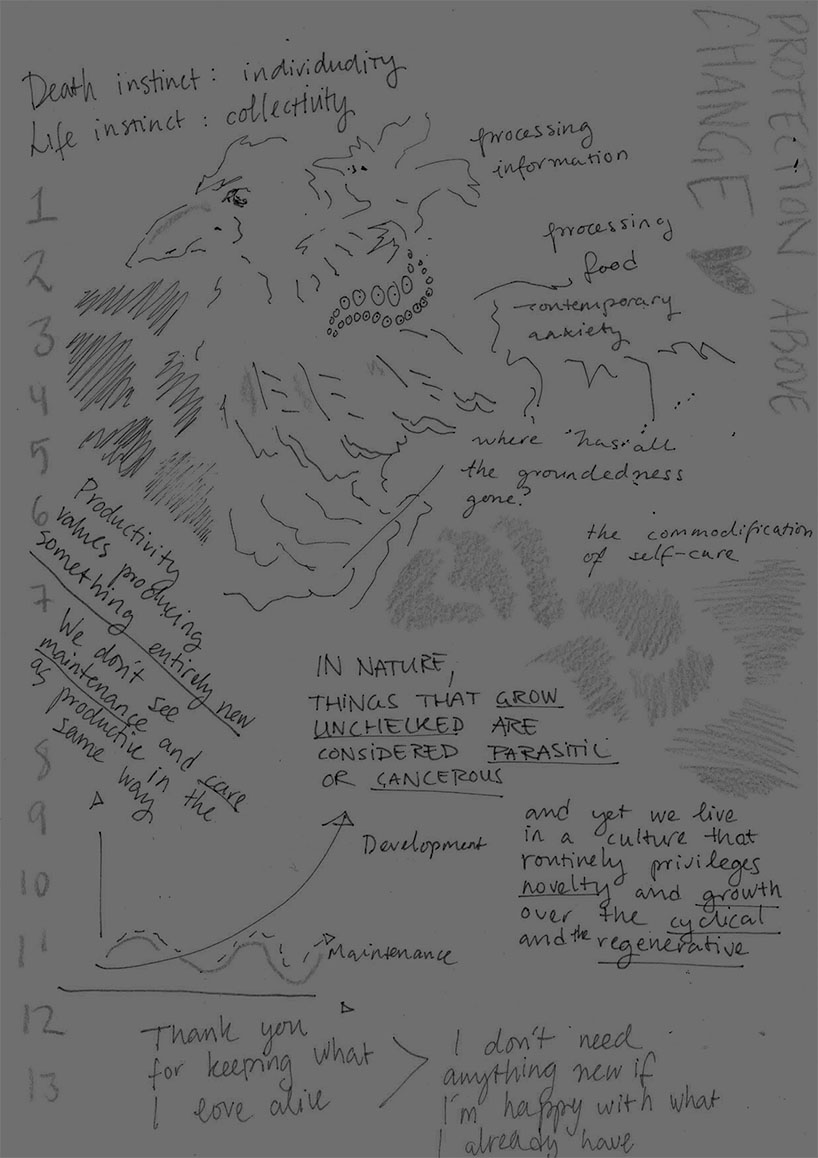
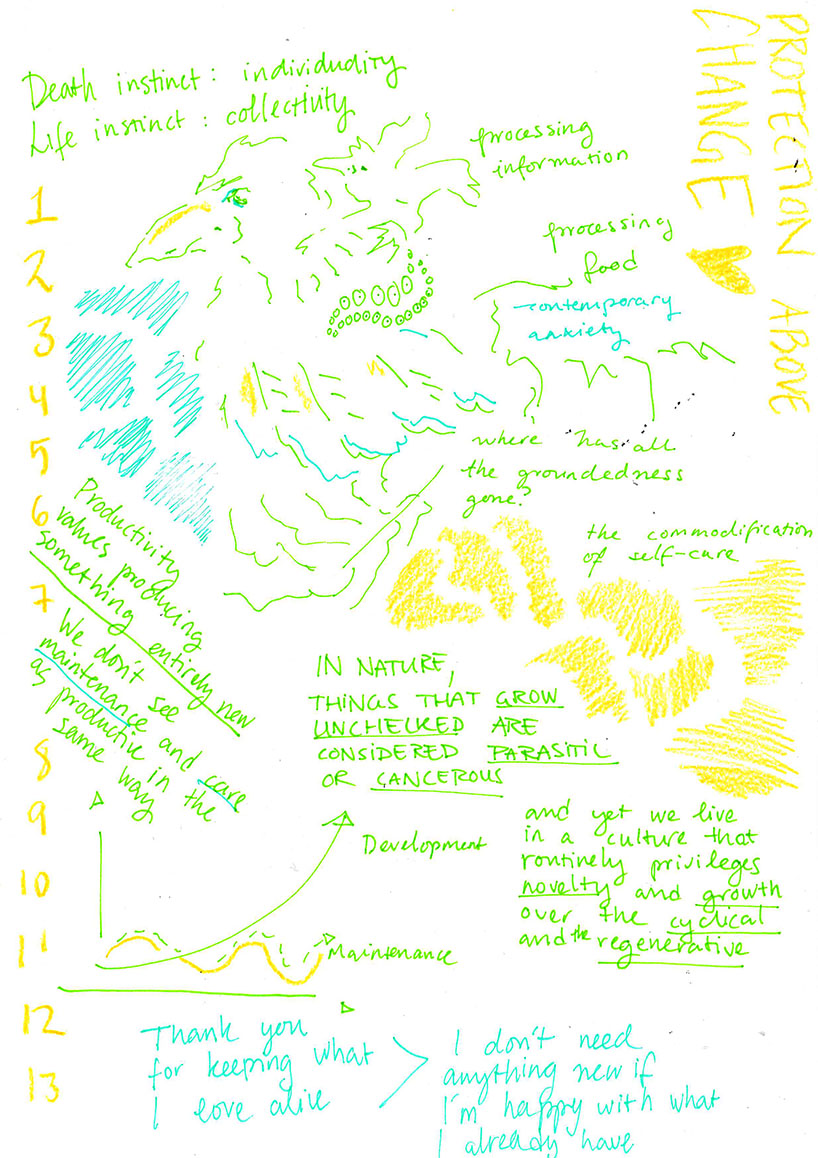
This small gesture marked a shift in how I take things in. After realising how hollow the endless scrolling on TikTok felt, I began intentionally slowing my intake, breaking information apart to understand it. I have come to think of this as a kind of “breaking into bites”: isolating a fragment that feels meaningful and staying with it a moment longer.
Often, this happened while listening, drawing, and writing intuitively; pausing and rewinding to then responding to them through text or image. Breaking information apart and reassembling it in this way became a way of moving from consumption toward digestion.
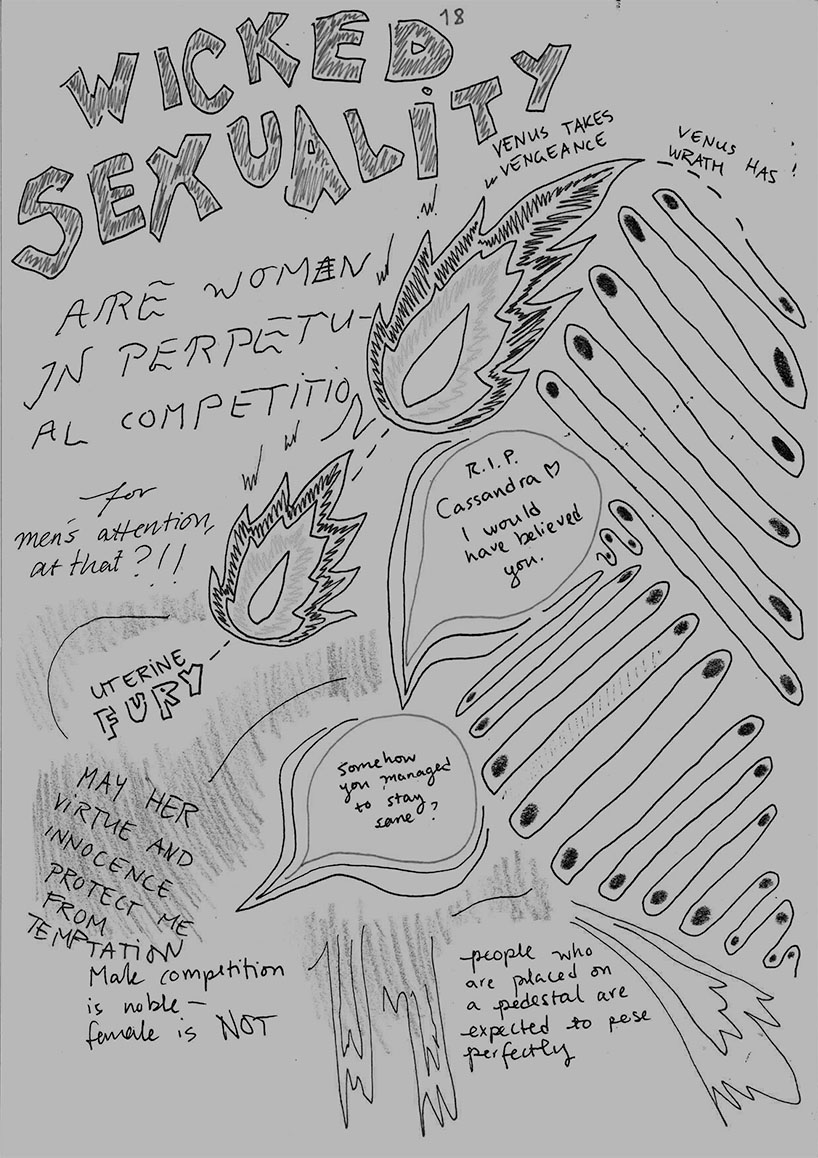
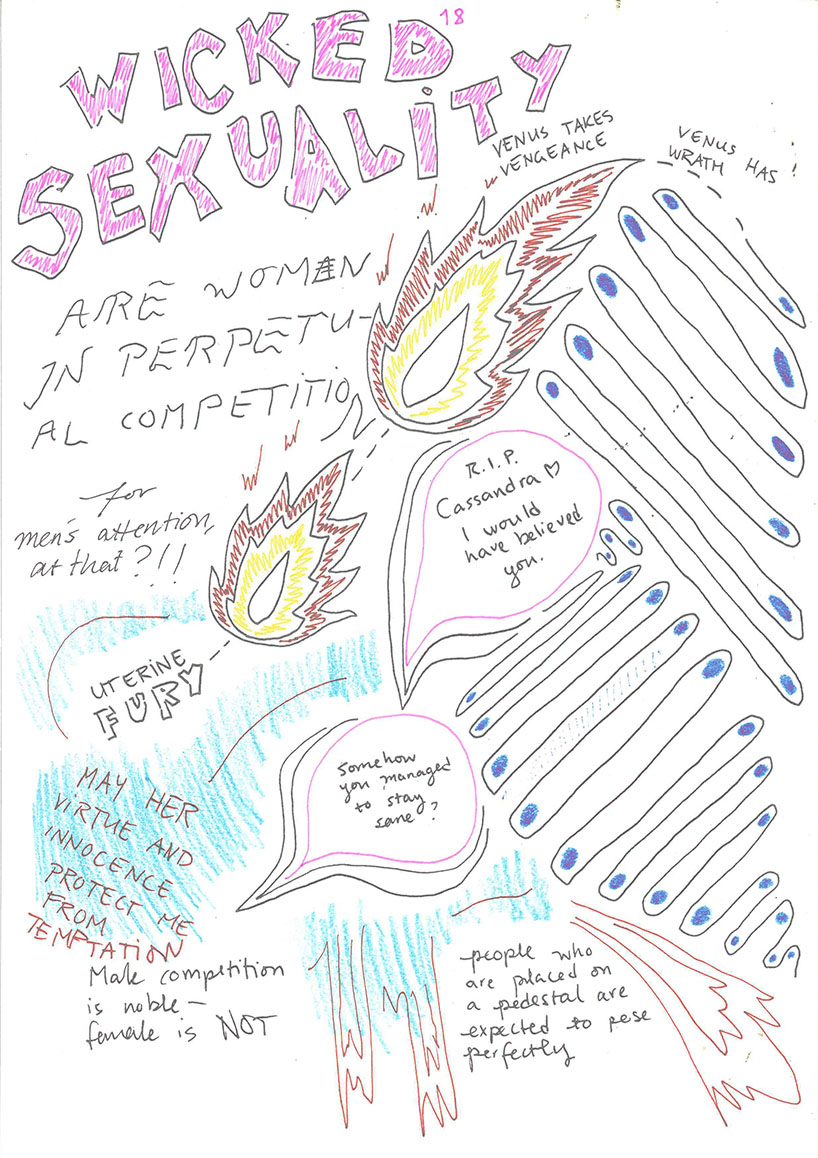
This approach of breaking down information and reflecting on it through text and image resonates with the work of Portuguese artist Priscila Fernandes, particularly her exhibition News Stand. In this project, Fernandes processes current events by translating them into drawings, as a way of processing violence and terror. The title refers to the familiar newspaper stand, a site typically associated with the rapid distribution and consumption of information, while subtly disrupting that expectation. Rather than facilitating the quick intake of news, she slows it down, isolating and into something that can be held, examined, and reflected on.
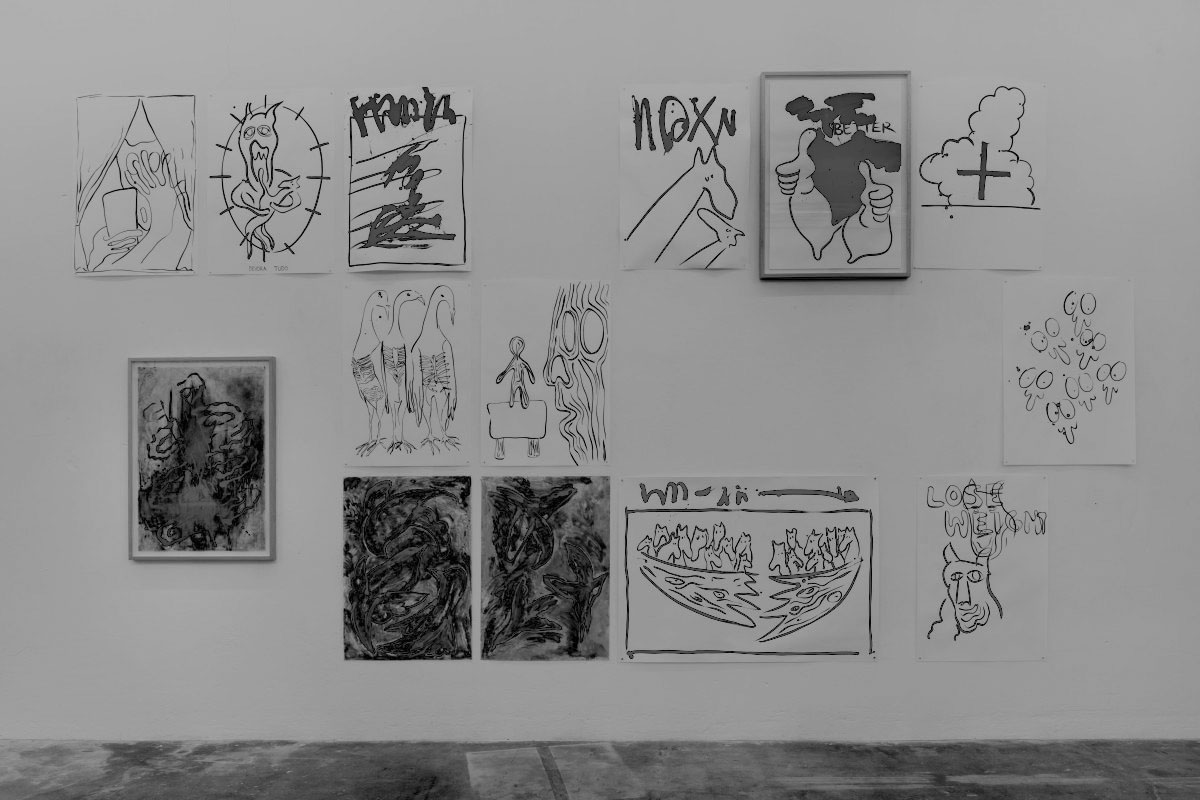
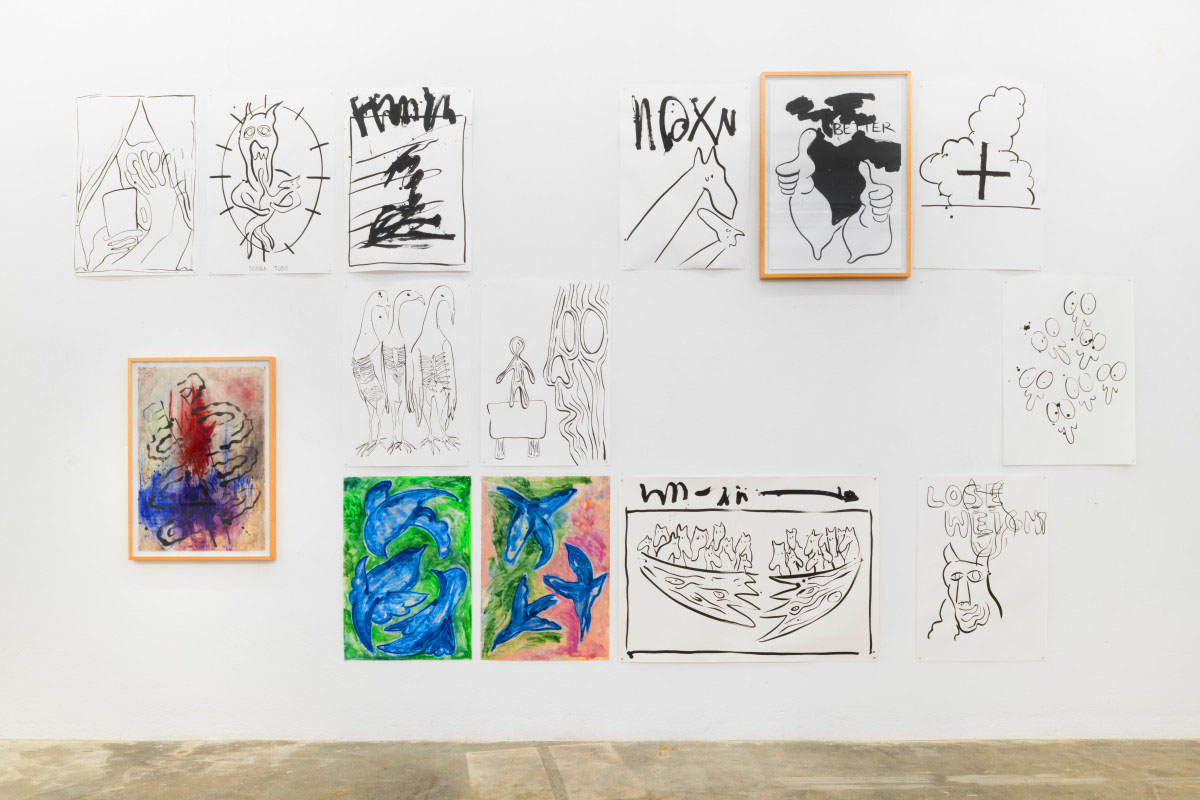
I see in this method a clear parallel to my own process, where instead of letting information pass through, I intercept it. Through writing and drawing, I force my mind to move from passive reception to , preventing the information from being ‘swallowed’ whole and unexamined. This process functions as a sort of manual ‘chewing’ of the material, stripping it of its original speed into a form that I can actually hold. Here, the act of making allows for information to become a substance that I actively shape instead of a signal leaving nothing behind.
PHASE II
Metabolising
I still have all the writings and drawings from that initial breaking-down phase, but returning to them now feels different. The immediacy is gone; the fragments feel harder to grasp, their original spark slightly dampened without the context in which they were originally delivered. I re-read sentences or look at surrounding doodles for clues of context, trying to understand what made me stop in the first place. It is here, in this space between capturing and understanding, that the real work of digestion begins.
Breaking information into bites – as described in Phase I – is a meaningful step towards information becoming nourishment, but it is only a part of a larger process. On its own, a fragment is just a record of an encounter; it creates the conditions for reflection but does not guarantee it. Returning to the metaphor of digestion, just as food must be digested after it is broken down, information must be processed and absorbed before it can become meaningful knowledge.
In philosopher Friedrich Nietzsche’s use of digestion as a metaphor for thinking, he suggests that thought is not about indiscriminate intake, but selection – the learned ability to affirm or refuse. This act of selection requires a conscious engagement that fundamentally interrupts the mindless consumption I recognised in my habit of scrolling. In this view, information cannot simply be swallowed; to truly take hold, it must be filtered, metabolised, and transformed. In Thus Spoke Zarathustra, Nietzsche writes:
“All-satisfiedness, which knoweth how to taste everything, – that is not the best taste! I honour the refractory, fastidious tongues and stomachs, which have learned to say “I” and “Yea” and “Nay.” To chew and digest everything, however – that is the genuine swine-nature!”
Nietzsche’s concept of taste frames thought as an active process; a “digestive” labour that transforms raw intake into something internal and personal. This idea of intellectual metabolism became central to my own process, but also exposed its limitations.
After breaking information into fragments through drawing and writing, I spent weeks sitting with them, revisiting and reworking the pieces to see how their over time. While this slowed engagement created a sense of connection, it also raised a question: was I actually processing these fragments, or merely hoarding them?
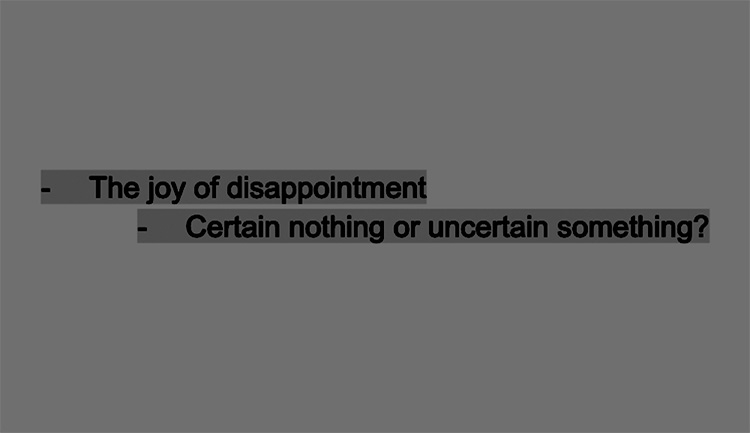
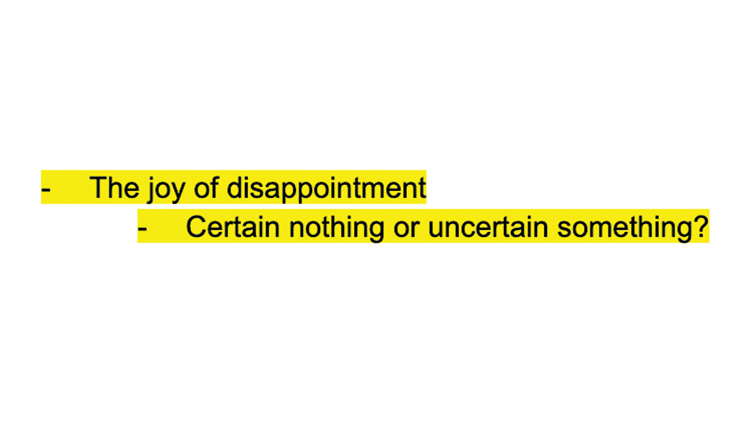
Nietzsche’s metaphor requires both absorption and refusal, yet my process lacked that final act of elimination. It mirrored Priscila Fernandes’ approach – using drawing to work through information without necessarily filtering it. While this added depth, it risked mere accumulation: collecting information without transforming it into knowledge. This tension between holding and letting go shifted my focus from simply breaking information down to questioning how it is metabolised, and crucially, what is allowed to remain.
Inspired by Nietzsche’s selective approach, I began dissecting my drawings and writings. I isolated elements that resonated and , rather than trying to force them back into their original narrative. This slower rhythm – of deconstructing, reflecting, and reapproaching – felt foreign. It required resisting an internalised belief that value is measured by speed, and that information must flow continuously to be useful.
My attempt to find room for reflection aligns with several artistic practices that reclaim meaningful engagement by shifting the rhythm of attention. I encountered a profound example of this earlier this year at Museum Voorlinden: Counting the Rice by Serbian artist Marina Abramović. In this exercise, participants spend an hour individual grains of rice and lentils. The task is intentionally repetitive, often provoking initial frustration or boredom. Yet, as the minutes pass, the act shifts the participants’ attention, making it sharper, more deliberate. In this way, the exercise functions as a training in patience, an invitation to remain with the material until the impulse to move on subsides, allowing a more active mode of engagement to emerge.
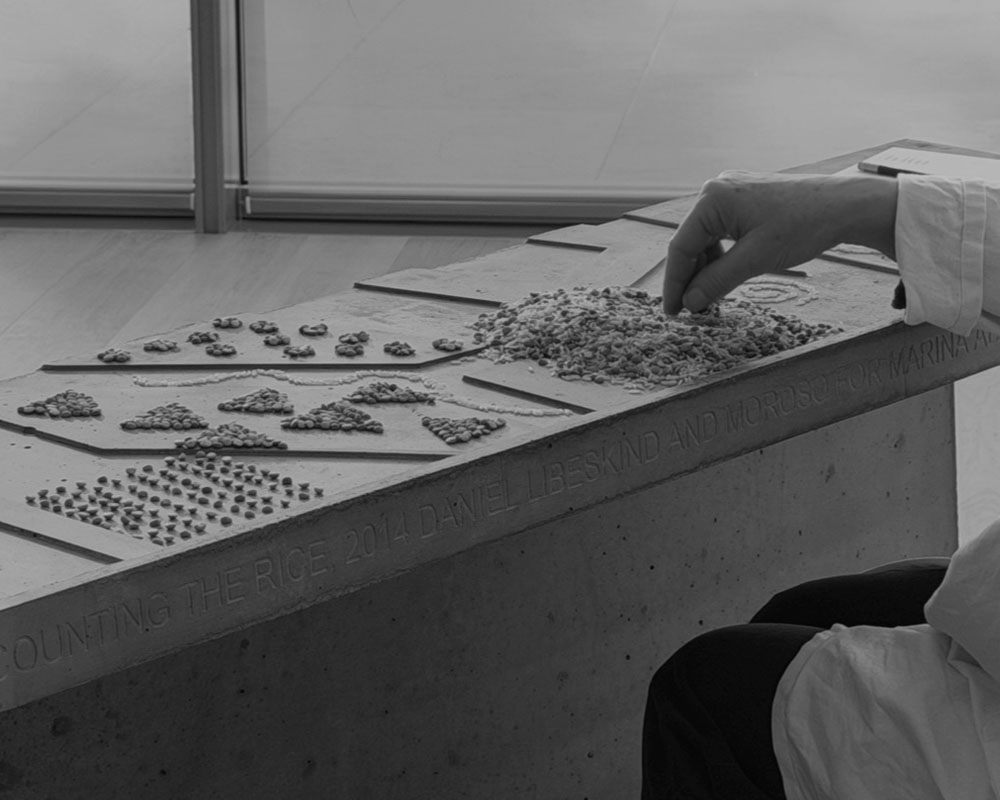
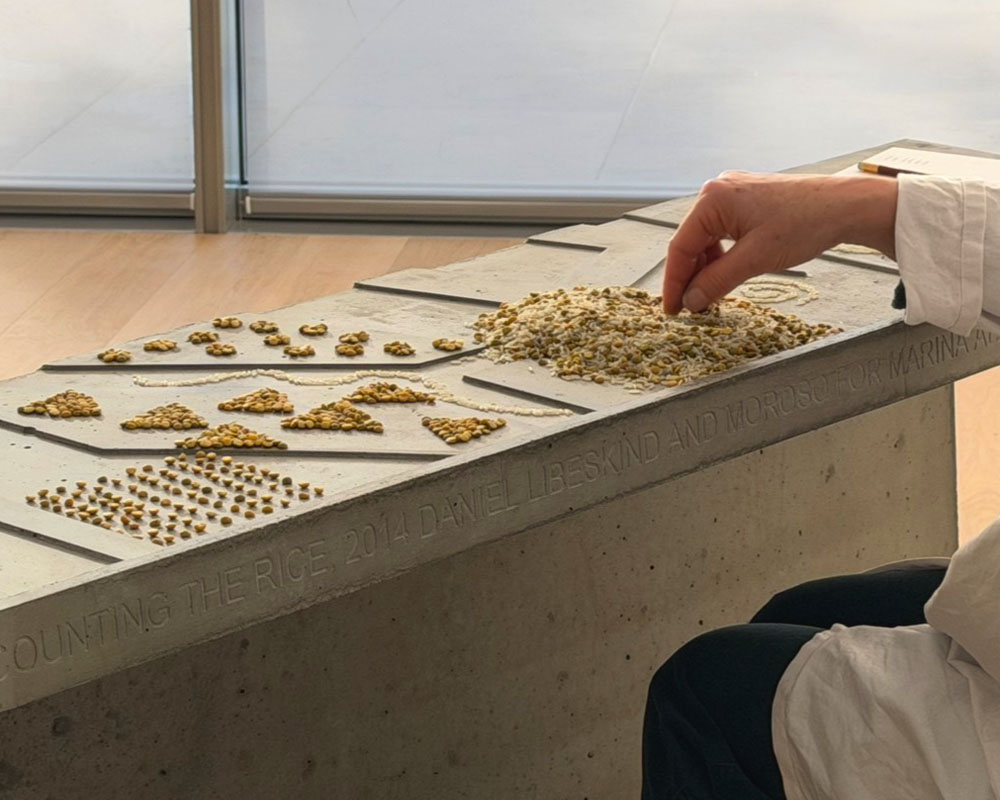
I see Counting the Rice as a model for the “intellectual metabolism” informing my project, as it requires a willingness to sit with ideas even when they feel dense or unresolved. Just as the body needs time to extract nutrients from food, the mind requires a sustained encounter to transform fragments of information into understanding. This realization led me back to my own archive of drawings and writings, where I forced myself to “stay” by reworking them in new contexts.
For example, a single phrase noted down while listening was initially just a disconnected bite. By returning to it weeks later – rephrasing it, weaving it with other fragments from other sources – I allowed the content to evolve rather than fixing it in a stagnant form. Metabolism, then, became a repetitive, manual act of re-approaching, re-arranging, and re-positioning. This was a fundamental shift in priority, favouring the slow labour of letting an idea take root over the hollow efficiency of maximising intake at the expense of understanding.
PHASE III
Discarding the Waste
Sifting through the material produced by reworking my initial fragments, I find my perspective has shifted. By pulling these ideas from Phase I into new environments, I have forced a natural filtration: the trivial fragments take less space, while the substantive have grown more resonant in their new contexts. This shift reveals that mental digestion depends as much on elimination as on intake. To turn information into nourishment, the mind must mimic the body: extracting what is vital and, crucially, discard the rest. This final act of rejection prevents the essential from being buried, allowing only the most meaningful ideas to truly take root.
The relentless nature of contemporary media environments hinders the reflection required to distinguish meaningful information from disposable noise. Without this distinction, the essential “elimination” of trivial input becomes impossible. Algorithmically curated feeds and infinite scrolls on platforms such as TikTok, deliver a stream of content that encourages continuous consumption without reflection. As Neil Postman warns in Amusing Ourselves to Death, we are being rendered “unfit to remember” because information is stripped of the context needed to organise it into meaning. When a fact’s only context is the next meaningless short-form video, no patterns can be discerned. What remains is constant intake without elimination; a state that leaves no space for ideas to settle, much less be metabolised.
In his book What Design Can't Do, designer and writer Silvio Lorusso questions the designer’s complicity in mindless consumption. He rejects the assumption that design should optimize for speed and volume, arguing instead for the necessity of boundaries. By replacing endless streams of content with finite selections or intentional pauses, Lorusso proposes a more narrowed focus. For him, these constraints are not for simplification, but a tactical defence against important information getting buried under the weight of “efficient” but empty data.
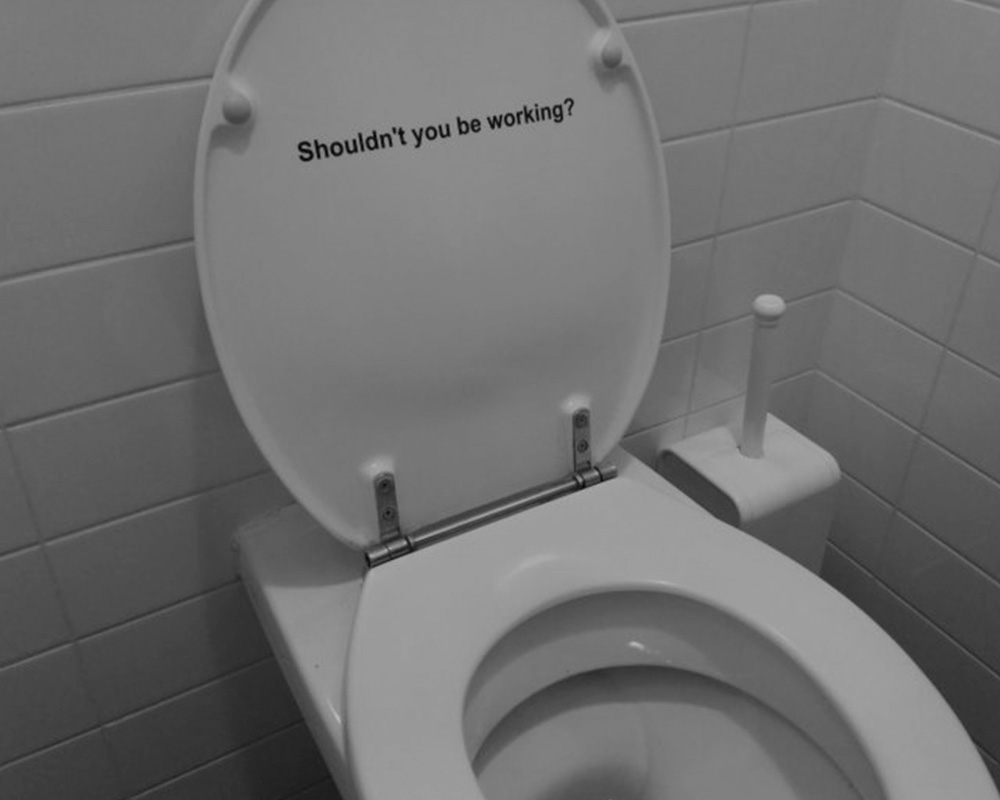
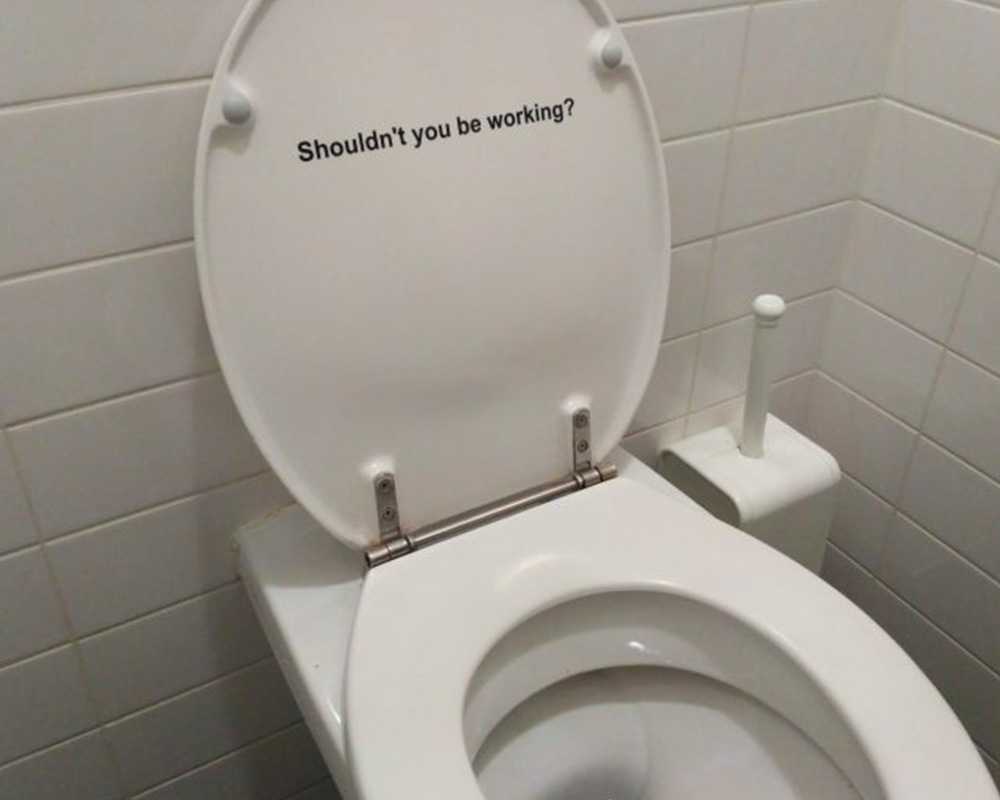
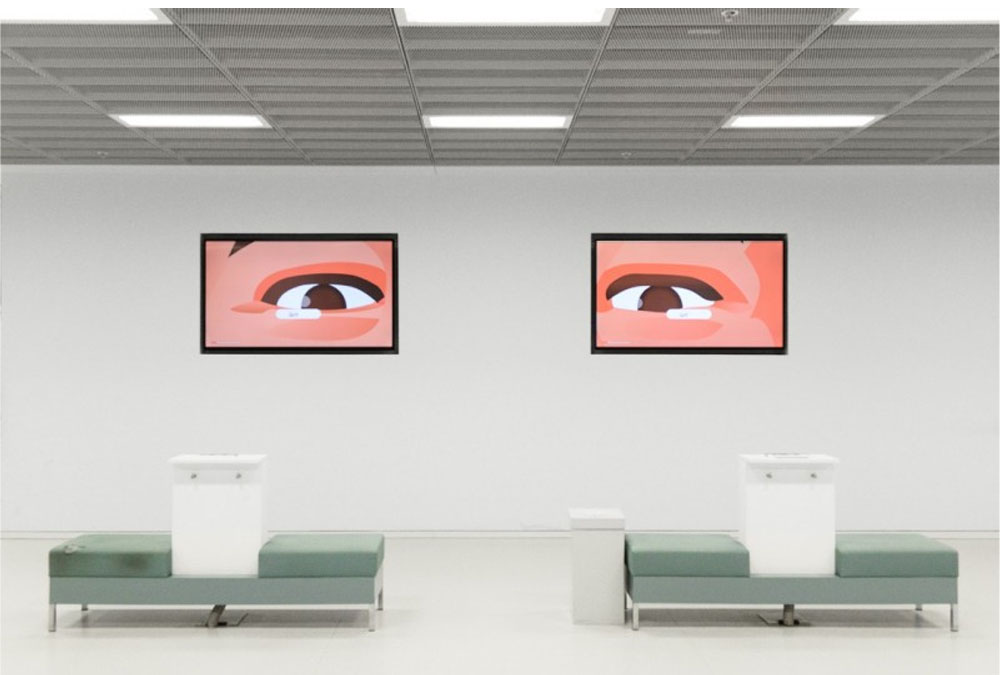
Lorusso’s project, Shouldn't You Be Working?, translates this theory into a physical intervention. By de-contextualising a browser extension that interrupts online activity with questions about productivity and its prompts onto physical banners and stickers, he manifests the “intentional pause” he advocates for in What Design Can't Do. These objects function as tactile boundaries; by dragging the invisible pressures of digital efficiency into the real world, Lorusso forces a confrontation with the systems that govern our time, creating the very space for reflection that the infinite scroll undermines.
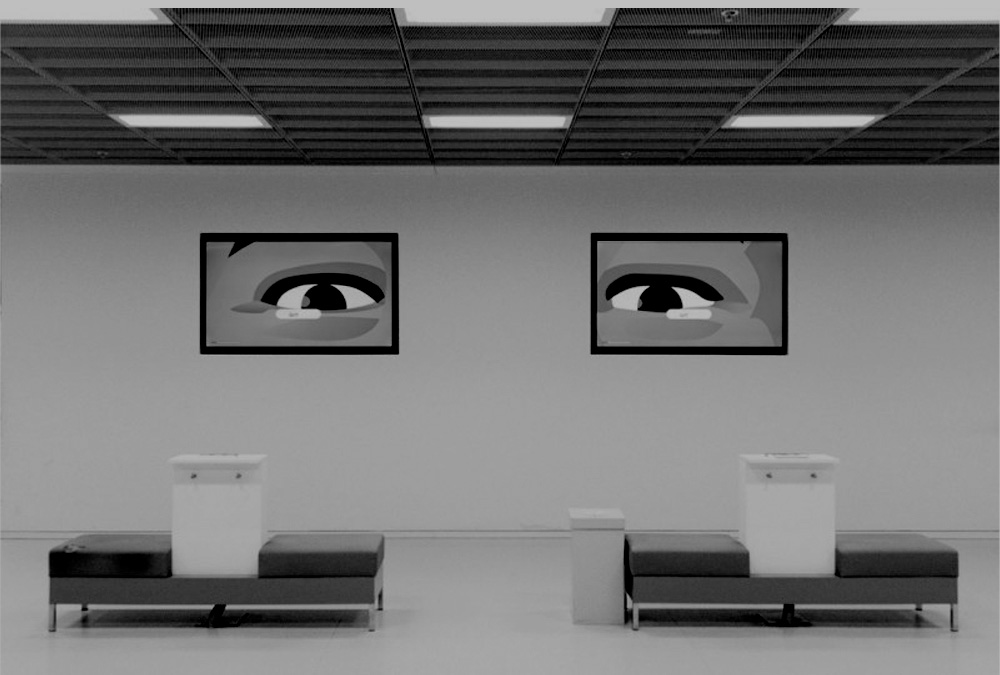
A contrasting critique emerges in the installation Speed Reading, in which German artist Sebastian Schmieg presents text at a pace exceeding human comprehension. While Lorusso uses interruptions to slow the viewer down, Schmieg accelerates the flow of information until reading becomes a purely . By pushing velocity to the point of illegibility, he exposes a media logic that values the velocity of transmission over the depth of comprehension. Where Lorusso creates space, Schmieg eliminates it entirely to emphasise the condition: when information moves too quickly to be processed, it cannot be retained. Though their methods differ, both artists arrive at the same metabolic conclusion: without pause, selection, or elimination, digestion becomes impossible.
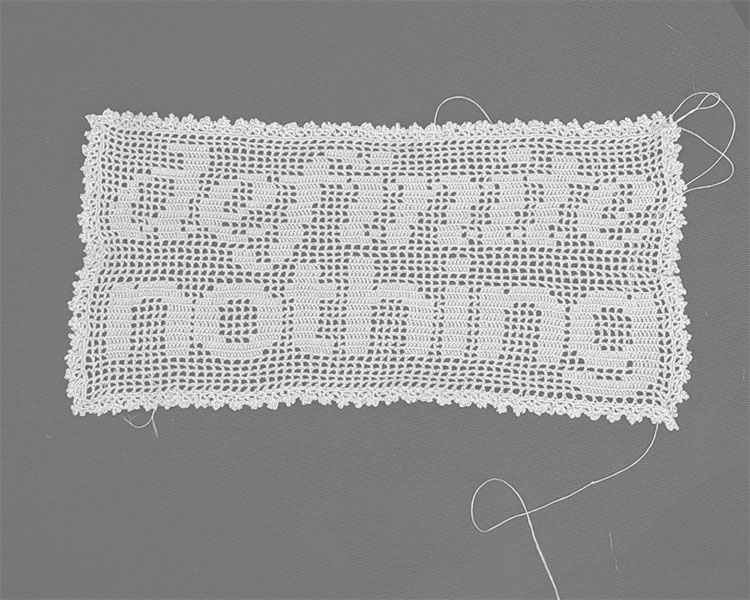
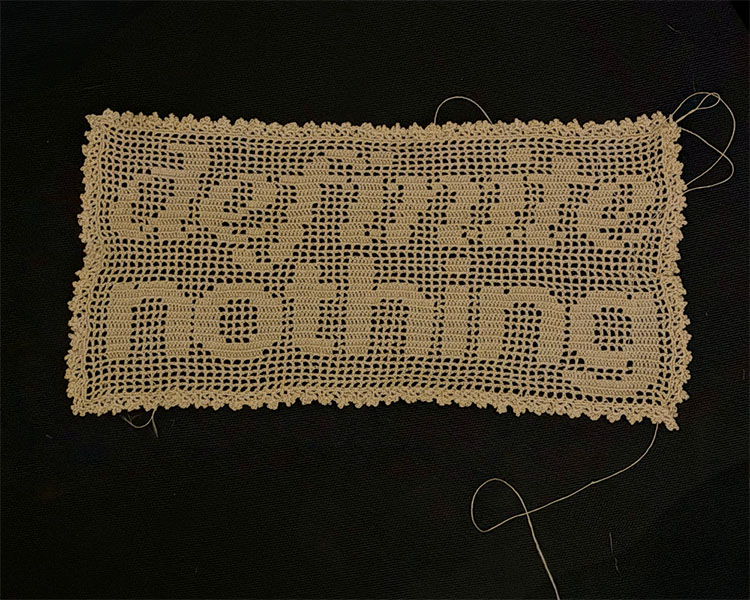
Within my own practice, I respond to this condition through a method of metabolic transformation. Instead of interrupting the flow like Lorusso or accelerating it like Schmieg, I reprocess the information itself – reorganising, condensing, and recirculating fragments to test their endurance. This method is exemplified in my exercise Instant Nourishment, a series of typographic that apply the visual and structural logic of commercial food packaging to abstract concepts. By utilising simplified language and clear hierarchies, the project literalises the idea of information as “nourishment” to the mind as food is to the body, and explores the tension between the speed of consumption and the depth of digestion.
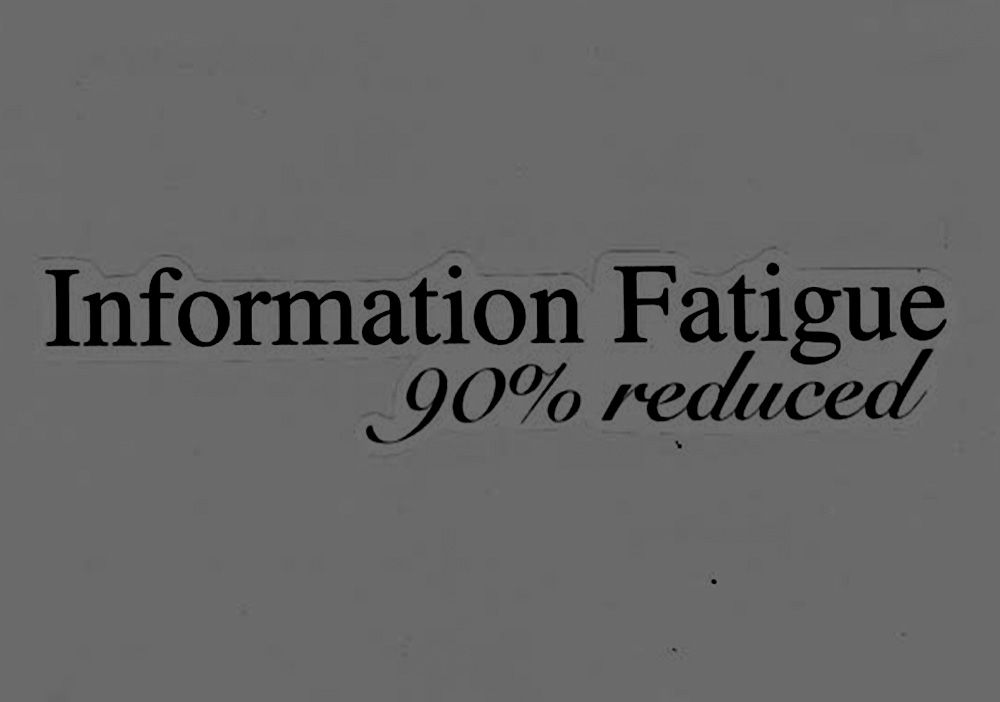
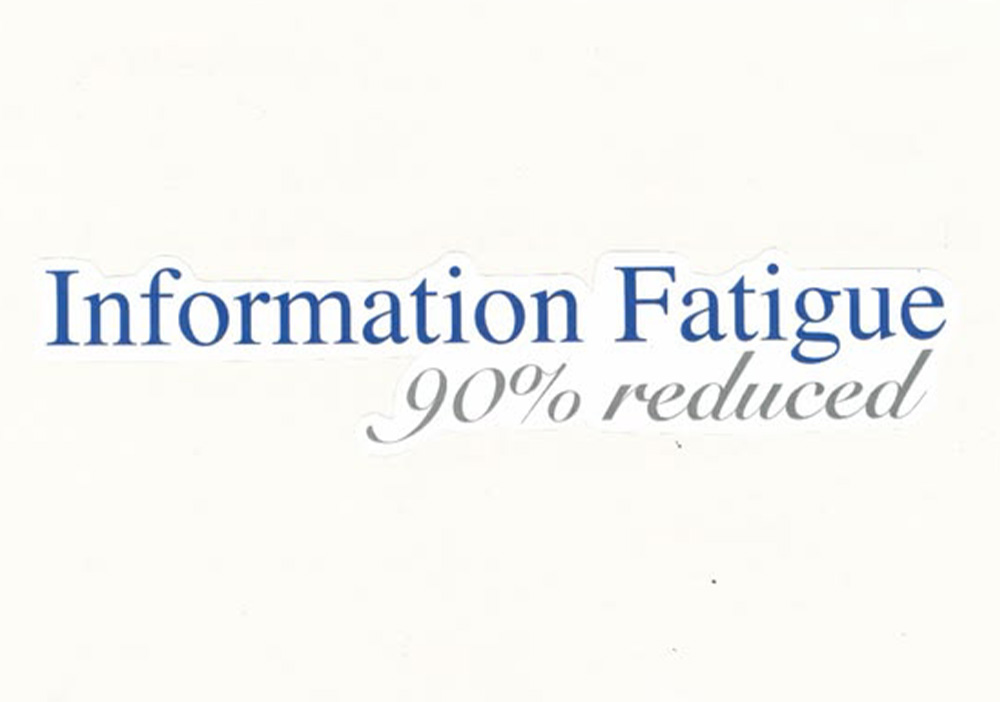
This displacement makes the tension between rapid legibility and deep comprehension perceptible. While the commercial aesthetic invites the viewer to skim, the nuanced content resists such a cursory glance. This mismatch reveals a critical boundary: while design can optimise the speed of delivery, it cannot bypass the labour of understanding. By forcing the eye to slow down where it expects to move fast, the work exposes the gap between merely seeing and truly metabolising.
In this way, transformation functions as a critical method. Adopting the logic of the “optimised unit,” I expose how ideas of efficiency threaten to strip information of its capacity for nourishment. Rather than resolving this contradiction, the work sustains it – making the mechanical conditions of mindless consumption visible while holding open the space for a slower, more deliberate engagement.
Conclusion
This project began with a simple observation: I was consuming information without processing it, without feeling nourished by it. The more efficiently information was delivered to me, the less it seemed to stay with me. What appeared to be a personal habit revealed a broader condition; one that encourages constant intake, leaving little space for reflection or refusal.
By treating design as a metabolic act, I have moved from the passive pacification Postman warned about toward a practice of active resistance. This inquiry proves that the threat to our autonomy is not just the abundance of information, but our inability to actively process and filter it. Through the process of breaking down, metabolising, and discarding, I have found that meaning is not found in taking in as much information as possible in the minimum amount of time, but in drawing deliberate boundaries to facilitate meaningful engagement.
To reclaim the agency over what is metabolised and what is discarded, we must honour the space for reflection and isolate the fragments that truly resonate. Allowing these ideas the room to take root while shedding the rest transforms consumption from a passive habit into a deliberate act of selection – a necessary refusal in the infinite stream of content that threatens to bury meaning in a flood of trivial information.
Graphic design plays an active role in shaping these conditions, influencing how information is taken in, how quickly it moves, and whether there is space for reflection. Because of this, design does not only communicate information; it also determines how that information can be digested. Rather than optimizing communication for faster consumption, design might also be used to introduce moments of friction: pauses, interruptions, and structures that resist immediate comprehension. These moments slow the flow of information just enough to allow for digestion.
My work does not aim to resolve the tension between speed and understanding, but to inhabit it. By using the visual language of “efficient” consumption to force a halt, I introduce the friction necessary for digestion. True nourishment, therefore, is found in this refusal to continue taking in; it is found in the creation of a space where ideas are not merely seen, but transformed into knowledge.
Credits and Information
The Royal Academy of Art, The Hague, 2026.
From Consumption to Digestion: Rethinking Engagement in a Contemporary Media Environment is a thesis by Eva Sóldís Bragadóttir.
Made possible with the valuable guidance of Barbara Neves Alves, Bart de Baets, Riet Wijnen, François Girard-Meunier, Thomas Buxó, Pascal de Man, and the continued support of family and friends.
I would like to acknowledge the use of AI tools, which assisted in refining the language of this essay.
This is to certify that to the best of my knowledge, the content of this thesis is my own work. This thesis has not previously been submitted for any degree or other purposes. I certify that the intellectual content of this thesis is the product of my own work and that all the assistance received in preparing this thesis and sources have been acknowledged.
Signed, Eva Sóldís Bragadóttir.