3. Nomad
3.1. Settlers or Migrants
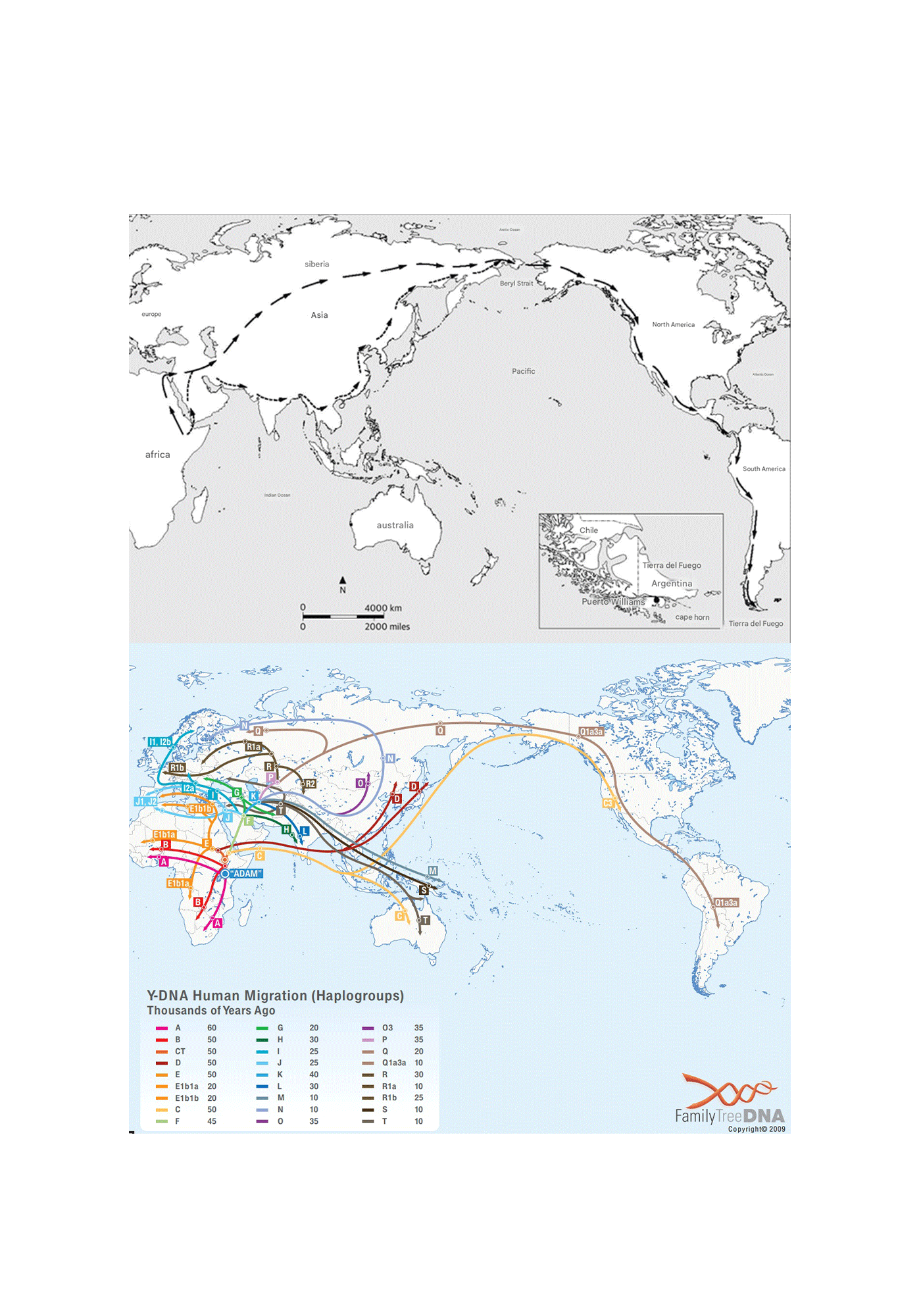
Each person who decides to move must have different reasons. I've been thinking about living in one country for the rest of my life felt boring. So it felt like I was living just for travel. Humans are essentially a migrating species and have a stronger instinct than any other mammal on Earth.a 60 The study of early human migration through DNA testing is said to be like an incredibly intricately intertwined traffic map.a 61 The Yaghan people who traveled the furthest in human history. Also the Haplogroups which are specific mitochondrial DNA gene patterns,a 62 were studied in the 1980s and 1990s by major scientists Allan Charles Wilson, Mark Stoneking, and Rebecca L. Cann as part of haplotype research. It refers to a group of people who share similar genetic patterns. This allows us to track how our ancestors moved.a 63 Having residences and nationalities is considered to be a human condition,a 64 but I believe the opposite is true. Humanity has migrated in an almost unprecedented number.a 65 This may be to force individuals to have a fixed identity in the middle of the current rising problems such as existential crisis and nationalism. Is it possible to have a Nomad identity that doesn’t belong anywhere and continues to migrate and live? Modern nomads are concepts altered from nomads of the past. Early Nomads who didn’t rely on the land simply ran away from oppression and exploitation to settle down and make a living.a 66 However, Current Nomads are a variant of the idea of nomads in the past. They are mainly people who can travel and perform their duties through mobile technology, which is for a certain class and requires a visa.a 67 Drawing from my own experience, long-term relocation is hard to be arbitrary anymore.
Born in a relatively decent time, I have had the opportunity to travel with little worry. However, until 1989, when overseas travel was fully liberalized in Korea, my parents could not get a passport for a simple overseas trip due to the country's poor economic situation at the time.a 68 Now, it seems unimaginable. It’s sad to realize that individual needs were always constrained by the boundaries of the state.a 69 And so far, this is still the case. I also thought that growing up in cease-fire country, this could be deprived at any time. Ironically, in a modern society where everything is unstable, the state doesn't seem to represent or guarantee 100% of any individual's safety.a 70 I came to believe that innocent civilians are always sacrificed within the framework of the state, especially when considering war and political movements. Conflicts between countries have changed the air routes that people around the world should share and this makes us re-examine the possibility of our movement itself.a 71 Throughout history, conflicts in the Middle East and the Russian-Ukrainian crisis have shown how ruling powers attempt to restrict physical movement.a 72
ㅤㅤㅤㅤㅤ
3.2. The Data Trails
Sociologist Zygmunt Bauman says in Liquid Modernity that contrary to the solid state in which society had a predictable structure after the Industrial Revolution until the middle of the 20th century, it now has values the possibility of growth and freedom.a 73 This change can be linked to the digital world and the social mobility we experienced during the pandemic, which ignited a new sense of social solidarity that crossed physical boundaries.a 74 In this process, fitness platform such as Strava have created connections across the online world as users actually have to walk.a 75 However, we are already living in the world of Cyber-Physical Systems even without using a specific platform.a 76 If fitness apps are a secondary choice for individuals, real-time services and information provided by map apps are essential elements of life for us on the go. This shift highlights the growing interaction between physical beings and the digital environment and demonstrates how technology is becoming an increasingly integral part of our lives.
Such as real-time services are defined by velocity and accuracy with users contribute greatly to a company's ability to have vast amounts of data.a 77 Even here, the platform interact with users and exchange precision and convenience equally. Maps want to know our routes and ask about our experiences. When we encounter the live congestion service on Google Maps and the cookie pop-up on the website are clever enough to induce users’ tacit consent.a 78 This can be seen as an example of data collection under the guise of a feedback loop.a 79 A former U.S. intelligence agent Edward Snowden who exposed the dangers of large-scale state surveillance.a 80 He highlighted abuse of power related to such metadata collection and state surveillance work.a 81 Over the past 25 years, major U.S. tech companies called GAMAMa 82 have been supported by the U.S. government’s social surveillance structure to promote the spread of surveillance capitalism.a 83 The phenomenon of data centralization through corporate login systems creates a ‘walled garden’,a 84 which fosters a more asymmetric and manipulated world through data monopoly, creating a dominant power even in the digital ecology.a 85 After all, big tech companies appear to be platforms that work with users, but we can only contribute to a certain extent and don't have the authority to modify our own data.a 86 This is due to the structure in which corporations use information and advantageously grow their pies.a 87 As new digital services emerge, it becomes crucial to consider whether these systems are beneficial to the public interest or solely corporate goals by making users dependent on their offerings. If we are not aware of the true purpose, we will be stuck in a deceptive loop.
By exploiting the vulnerabilities of these technologies, Simon Weckert’s tested how easily this system could be manipulated in his work, ‘Google Maps Hacks’. Many businesses rely on real-time location technology,a 88 due to cost and scalability reasons, startups make use of Google's huge mapping system infrastructure as a third part provider including its own systems.a 89 This leads to the risk of causing secondary damage under the influence of fake content provided by Google API.a 90 The task that leaves questions about whether its permissions and vulnerability are reliable.a 91 Ultimately, digitalization exposes the danger that our personal identity and social relationships are all reduced to data and we don't even know where all this data flows. Perhaps we are inhabitants trapped within the framework of large corporate control infrastructures and playing a defined role. Why do we share the specifics of our movements and why do platforms want to store our details. In the end, individuals must recognize and judge reality in the flood of information, how the online builds and makes us believe in the environment we actually see.a 92
Miller, Sam. Migrants: The Story of Us All. Abacus, 2023, 1–20.
↵
Ibid.
↵
“Haplogroups Explained.” 23andMe Blog, Feb 2025, blog.23andme.com/articles/haplogroups-explained.
↵
See Mitochondrial DNA and human evolution carried out by scientists Allan Charles Wilson, Mark Stoneking and Rebecca L. Cann, and published in Nature journal on January 1987.
↵
“Nationality and Statelessness: Handbook for Parliamentarians N° 22.” United Nations High Commissioner for Refugees. July 2014, 5–6.
↵
World Migration Report 2024. International Organization for Migration. IOM, 2024, https://worldmigrationreport.iom.int/msite/wmr-2024-interactive/.
↵
Mongolian Nomads’ Ultimate Dilemma | SLICE I Full Documentary. YouTube, Dec. 2022, www.youtube.com/watch?v=_NcTKQmdKl8.
↵
“What Is a Digital Nomad Visa, and How Can You Get One?” Oyiza, Happiness. UnicrossBlog, Jan 2025, unicrossblog.com/what-is-a-digital-nomad-visa-and-how-can-you-get-one.
↵
기록으로 만나는 대한민국 > 생활 > 해외여행 자유화. https://theme.archives.go.kr/next/koreaOfRecord/globalTravel.do
↵
Bauman, Zygmunt. Liquid Modernity. Blackwell Publishing, 2000, 38–41.
↵
Bauman, Zygmunt. Liquid Modernity. Blackwell Publishing, 2000, 106–109, 182–189.
↵
Statista. “Flight Paths Rerouted by Airlines Due to the Conflict in Ukraine 2022.” Statista, Apr 2024, www.statista.com/statistics/1299884/flight-paths-rerouted-ukraine-conflict.
↵
Bauman, Zygmunt. Liquid Modernity. Blackwell Publishing, 2000, 119–120.
↵
Bauman, Zygmunt. Liquid Modernity. Blackwell Publishing, 2000, 5–6.
↵
Bagshaw, Bella. “Organizer Q&A: Feeling so Real – How Junction2 Organizers Create Community in the Digital Space.” Festival Insider, 8 Jan. 2021, festivalinsider.com/articles/feeling-so-real-how-junction2-organizers-create-community-in-the-digital.
↵
Features. Strava, https://www.strava.com/features
↵
“Introduction to CyberPhysical System.” GeeksforGeeks, July 2024, www.geeksforgeeks.org/introduction-to-cyber-physical-system.
↵
“Big Data Defined: Examples and Benefits | Google Cloud.” Google Cloud, cloud.google.com/learn/what-is-big-data?hl=en.
↵
CookieScript. What Are Dark Patterns in Google Consent? 7 May 2024, cookie-script.com/blog/what-are-dark-patterns-in-google-consent.
↵
Morgan-Jones, Nick. “UX: Creating Natural Experiences with Feedback Loops.” Medium, June 2019, medium.com/codeandco/ux-making-experiences-feel-natural-with-feedback-loops-ce4eb333f99c.
↵
The Guardian. “NSA Whistleblower Edward Snowden: ‘I Don’t Want to Live in a Society That Does These Sort of Things.’” YouTube, 9 July 2013, www.youtube.com/watch?v=0hLjuVyIIrs.
↵
Ibid.
↵
“Topic: Google, Amazon, Meta, Apple, and Microsoft (GAMAM).” Statista, Mar 2025, www.statista.com/topics/4213/google-apple-facebook-amazon-and-microsoft-gafam.
↵
Kilroy, Richard J. Jr., Ph.D. "No Place to Hide: Edward Snowden, the NSA, and the U.S. Surveillance State. By Glenn Greenwald, New York, NY: Metropolitan Books, 2014." Journal of Strategic Security, vol. 9, no. 3, 2016, 99–102. DOI: http://dx.doi.org/10.5038/1944-0472.9.3.1552. Available at: https://digitalcommons.usf.edu/jss/vol9/iss3/7.
↵
Blockthrough. "The Walled Gardens of the Ad Tech Industry Explained." Blockthrough, Jan 2023, https://blockthrough.com/blog/the-walled-gardens-of-the-ad-tech-industry-explained/#What_is_a_walled_garden_on_the_Internet.
↵
Staff, Fp. “How Google Maps Is Making It More Difficult for Palestinian Users to Navigate the West Bank.” Firstpost, 30 Dec 2024, www.firstpost.com/tech/how-google-maps-is-making-it-more-difficult-for-palestinian-users-to-navigate-the-west-bank-13848547.html.
↵
See the real case. I’d Like to Change the Name on the Map. Google Maps Community. support.google.com/maps/thread/103274735?hl=en&msgid=106213278&sjid=18190617991951499912-EU.
↵
Weronika. “37 Google Maps Statistics and Interesting Facts.” Center AI, Jan. 2025, center.ai/blog/google-maps-statistics-and-interesting-facts..
↵
Why Uber Uses Google Maps: Introduction to APIs (Encore). www.techfornontechies.co/blog/why-uber-uses-google-maps-introduction-to-api.
↵
AirMapView. airbnb.io/AirMapView.
↵
Doffman, Zak. “Google Maps Hit by 11 Million Fake Businesses in ‘Costly and Dangerous Deception.’” Forbes, June 2019, www.forbes.com/sites/zakdoffman/2019/06/20/google-maps-responds-to-dangerous-deception-of-11-million-fake-businesses/?utm_source.
↵
Disruption Network Lab. “Google Maps Hacks. Simon Weckert.” YouTube, Nov. 2020, www.youtube.com/watch?v=yGXzjYZxcQA.
↵
Bauman, Zygmunt. Liquid Modernity. Blackwell Publishing, 2000. 154–155.
↵